级
Character Story & Explanation
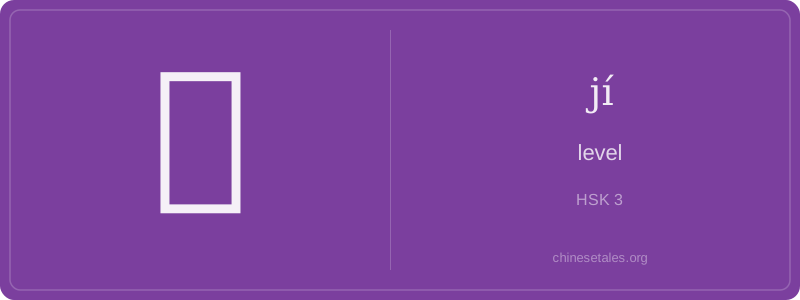
The earliest form of 级 appears in bronze inscriptions as two parallel horizontal lines stacked above a knot-like shape — representing *steps* or *rungs*, not of a ladder per se, but of a knotted rope ladder used in ancient ritual ascents or mountain travel. The left side evolved from 糸 (sī), meaning ‘silk thread’, hinting at finely twisted cords used to secure those rungs; the right side simplified from 及 (jí), which originally depicted a hand reaching down — suggesting ‘attaining’ or ‘reaching a step’. Over centuries, the knot morphed into 呙 (a variant of 及), and the silk radical 纟 remained firmly anchored on the left, grounding the character in material craft and precision.
By the Han dynasty, 级 had shifted from literal rope steps to metaphorical ‘ranks’ — first in military organization (《汉书》 mentions ‘千夫之级’ — ranks of a thousand men), then in civil bureaucracy. Its visual logic held: just as each knot in a rope ladder marks a distinct, climbable position, each 级 marks a discrete, attainable station in human hierarchy. Confucius never used 级 directly, but Mencius (《孟子》) described moral cultivation as ascending ‘levels’ — later commentators explicitly mapped those onto 级. The character’s enduring power lies in this fusion: textile craftsmanship + embodied ascent = social order made visible.
Think of 级 (jí) as Chinese’s answer to the Western 'tiered cake'—not the dessert, but the *structure*: each layer represents a distinct rank, grade, or step in a hierarchy. Unlike English ‘level’, which often feels abstract (e.g., ‘a high level of skill’), 级 is inherently *ordinal and institutional*. It’s the backbone of systems: school grades (一年级), military ranks (上校), earthquake intensity (七级), and even Wi-Fi signal bars (满三级). It implies measurable, socially recognized position—not just height or depth, but *status with a number attached*.
Grammatically, 级 almost always follows a numeral or classifier (e.g., 第一級, 三級, 高級) and rarely stands alone. You won’t say ‘I am 级’—you say ‘I’m in the third grade’ (我在三年级). It also appears in compound nouns like 年级 (grade level in school) and 级别 (rank/level), where it’s inseparable from the concept of formal categorization. A classic mistake? Using 级 where you need 等 (děng) for ‘degree’ (e.g., 等级 exists—but 等 alone means ‘class’ or ‘category’, while 级 specifies the numbered rung on that ladder).
Culturally, 级 reflects China’s deep-rooted emphasis on structured progression: whether climbing the civil service exam ladder (科举 → modern 公务员考试), advancing in martial arts belts (though borrowed), or even ranking hotpot spice levels (微辣、中辣、特辣—no ‘级’ used there! That’s a fun exception showing its *selective* formality). Learners often overuse it—slipping ‘级’ into casual contexts where native speakers would use 度 (dù) or just an adjective. Remember: 级 = official, numbered, systemic. Not poetic. Not vague. Not optional.