结
Character Story & Explanation
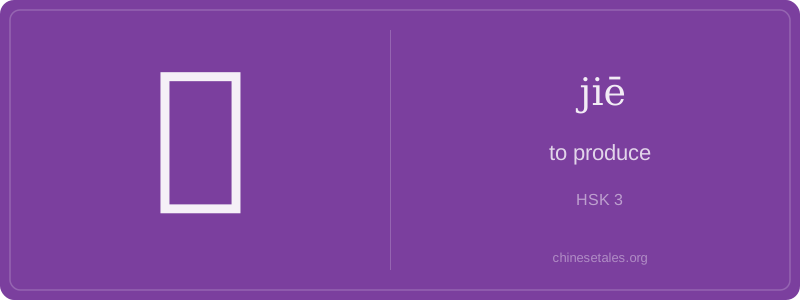
The earliest form of 结 appears in bronze inscriptions as a combination of 糸 (a stylized bundle of silk threads, later simplified to 纟) and 吉 (a phonetic component meaning ‘auspicious’). Visually, it depicted two strands being twisted together — a literal knot. Over time, the knot evolved into the lower part (吉), while the left-hand silk radical 纟 stayed constant, anchoring its meaning in connection, binding, and textile work. By the Han dynasty, the character had stabilized into its modern nine-stroke shape: four strokes for 纟 (two dots + two curved lines), then five for 吉 — no extra flourishes, just clean, functional weaving.
This knot wasn’t just decorative: in ancient texts like the Book of Odes, knots symbolized binding promises, sealing alliances, and — crucially — the fertile union of heaven and earth that yields harvests. So ‘knotting’ became synonymous with ‘producing’: the tied threads *generate* new forms, just as marriage (结 婚) or planting (结 果) initiates a cycle of emergence. Even today, when farmers say ‘树结桃子了’, they’re invoking that same ancient logic: connection begets creation.
Imagine a farmer in spring, gently tying twine around the base of a young fruit tree branch — not to restrain it, but to support its growth. Weeks later, tiny green fruits begin to form right where that knot was tied. That’s 结 (jiē) in action: not just ‘to tie’ or ‘to connect’, but specifically to produce — especially fruit, seeds, or outcomes that emerge from connection and cultivation. It’s earthy, biological, and deeply agricultural: you’ll hear it in phrases like ‘结瓜’ (jiē guā, ‘the vine produces melons’) or ‘结果’ (jiē guǒ, ‘to bear fruit’ — literally and figuratively).
Grammatically, 结 (jiē) is almost always a verb in this sense, used transitively with plants or abstract results: ‘这棵树今年结了很多苹果’ (zhè kē shù jīn nián jiē le hěn duō píng guǒ). Note the past-tense particle 了 — crucial! Learners often mistakenly use 结 for ‘to conclude’ here (that’s jié), or forget that 结 (jiē) *requires* an object (you can’t just ‘jiē’ — you must ‘jiē fruit’, ‘jiē seeds’, ‘jiē friendship’). Also: it never stands alone as a noun — unlike 结 (jié), which *can* mean ‘knot’ or ‘conclusion’.
Culturally, this usage reflects China’s agrarian roots: growth isn’t passive — it’s an active, tied-together process. A common mistake? Using jiē when you mean ‘to end’ (e.g., ‘the meeting ended’ → 会议结束了, using jié). Remember: if something is *growing*, *forming*, or *bearing*, reach for jiē — and picture that knotted branch swelling with life.