绿
Character Story & Explanation
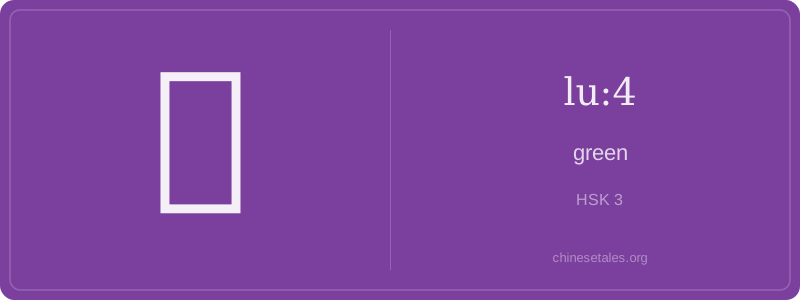
The earliest form of 绿 appears in bronze inscriptions as a compound: left side 糸 (sī, ‘silk thread’), right side 录 (lù, ‘record, list’—originally a pictograph of a hand holding a writing tablet). Why silk + record? Because ancient Chinese dyed silk with plant-based pigments—including the vibrant green from the indigo plant and leaf extracts—and meticulously logged dye recipes. Over centuries, 糸 simplified to 纟 (the ‘silk’ radical), while 录 streamlined its strokes into today’s six-stroke right side—preserving the link between color, craft, and documentation.
This origin explains why 绿 lives under the 纟 radical: it’s fundamentally about *dyed fabric*, not just light wavelengths. In classical poetry, green evokes renewal—Du Fu wrote of ‘green moss creeping up stone steps’ (苔痕上阶绿), where 绿 acts as a verb, painting stillness with growth. Even today, its visual structure whispers its history: the left ‘threads’ cradle the right ‘record’—a tiny archive of ancient chemistry, worn on the body and celebrated in verse.
‘Green’ in Chinese isn’t just a color—it’s a living breath: the rustle of bamboo groves, the damp coolness of spring tea leaves, the quiet hope in a city park after smog. Unlike English, where ‘green’ leans ecological or naïve, 绿 (lǜ) carries visceral, sensory weight—think the sharp tang of unripe plums (青绿) or the velvety depth of jade (翠绿). It’s rarely abstract; it’s *felt*—cool, fresh, alive.
Grammatically, 绿 is refreshingly flexible: it works as an adjective (那棵树很绿), a noun (红配绿), and even a verb in poetic or dialect use (绿了山岗—‘the hills turned green’). Crucially, it *never* takes the adjectival suffix -de (的) before nouns—so it’s 绿衣服, not *绿色的衣服 (though 绿色 *is* used formally, like in 绿色能源). Learners often overcorrect and add 的, betraying their English intuition.
Culturally, 绿 has layered resonance: it’s auspicious (green jade = harmony), but also carries cheeky modern slang—like 绿帽子 (lǜ màozi, ‘green hat’), meaning ‘to be cuckolded’, a taboo so potent that some hotels skip room 1408 (1-4-0-8 → yāo-sì-líng-bā → sounds like ‘ya-si-ling-ba’, near ‘ya-si-lǜ-ba’ — a playful, superstitious avoidance). Also, don’t confuse its tone: lǜ (fourth tone) sounds crisp and final—not luó or lū!