聪
Character Story & Explanation
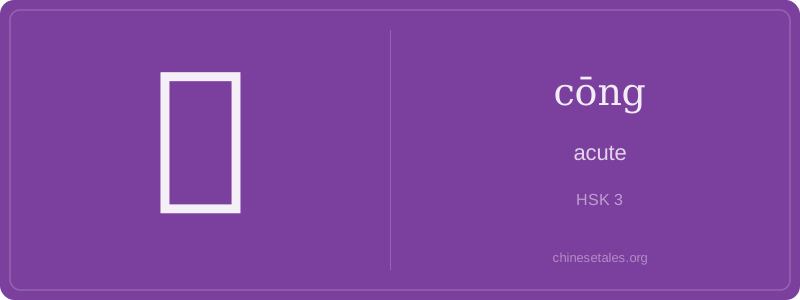
The earliest form of 聪 appears in bronze inscriptions around 1000 BCE: a simplified ear (耳) combined with two upward-sweeping strokes suggesting sound waves or attentive focus — not yet the modern ‘general’ (总) on top. By the Warring States period, scribes added the ‘general’ component (总, later simplified to 总 → now written as 总 without the ‘heart’ radical) above the ear, implying ‘comprehensive auditory awareness’. The 15 strokes crystallized in the Han dynasty seal script: 耳 (6 strokes) + 总 (9 strokes), visually merging ‘ear’ and ‘summing up’ — literally ‘hearing that gathers meaning’.
This visual logic shaped its meaning: from physical acuity (sharp hearing) in early texts like the *Book of Rites*, it evolved into intellectual discernment by the Tang dynasty. In Du Fu’s poetry, 聪 is invoked not for cleverness, but for moral clarity — ‘listening to virtue’. Even today, 耳聪目明 evokes holistic alertness, linking sensory precision to ethical awareness — a uniquely Chinese fusion of physiology and philosophy.
At its heart, 聪 (cōng) isn’t just ‘acute’ — it’s the Chinese word for *mental sharpness that rings true*, like a clear bell heard through quiet air. It describes quick comprehension, alert perception (especially auditory), and innate intelligence — but never arrogance. Think of it as ‘wisdom with ears wide open’. You’ll almost never see it alone; it’s a team player, always paired in compounds like 聪明 (cōngmíng, ‘intelligent’) or 聪慧 (cōnghuì, ‘keen-witted’). As an adjective, it modifies nouns directly: 聪明的孩子 (a bright child), not *‘he is聪’ — no standalone predicate use!
Grammatically, 聪 only appears in attributive position or within fixed two-character adjectives. Learners often mistakenly try to use it like English ‘smart’ — saying *‘Tā hěn 聪’ — which sounds jarringly unnatural. Instead, say Tā hěn cōngmíng (He’s very intelligent) or use it descriptively: 这个孩子耳聪目明 (This child has keen hearing and sharp eyesight — a classical idiom still used today).
Culturally, 聪 carries Confucian weight: it’s not just IQ — it’s moral perceptiveness. In the Analects, ‘耳聪’ implies listening well to elders and truth. A common learner trap? Confusing it with 听 (tīng, ‘to listen’) — but while 听 is action, 聪 is *capacity*. Also, note the tone: cōng (first tone) — mispronouncing it as còng or cǒng breaks the meaning entirely.