声
Character Story & Explanation
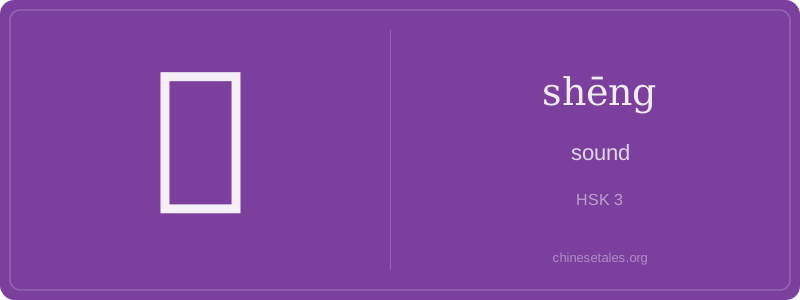
The earliest form of 声 appears in bronze inscriptions around 1000 BCE—not as a pictograph of ears or waves, but as a stylized *drum*! The top part (士) originally represented the drum’s stand or frame, while the lower components (like 聿 and 戊) depicted drumsticks striking taut hide. Over centuries, the drum imagery simplified: the drumstick strokes fused into the modern 耳-like shape beneath 士, and the stand evolved into the clean, upright 士 radical we see today—7 strokes total, each echoing rhythmic impact.
This drum origin explains why 声 connotes *intentional*, *social* sound—not ambient noise. In the Shijing (Book of Odes), 声 appears in contexts like 'the ruler’s voice commands harmony'—linking sound to authority and order. Even today, 声望 (shēng wàng, 'prestige') and 声援 (shēng yuán, 'voice support') retain that ancient sense of sound as active, communal force. The character’s visual rhythm—strong upper stroke (士) anchoring lively lower strokes—mirrors how human voice emerges: grounded, deliberate, resonant.
At its heart, 声 (shēng) isn’t just ‘sound’ as an abstract concept—it’s *audible presence*: the rustle of leaves, a shout, a whisper, even silence marked by its absence (e.g., 鸦雀无声 yā què wú shēng, 'not a sound from crows or sparrows' = deathly quiet). Unlike English ‘sound’, which can be physical vibration or auditory perception, 声 always implies something *heard*—often with emotional or social weight: a voice (声音), reputation (声望), or even a musical note (声调).
Grammatically, 声 is rarely used alone. It pairs tightly: as the second character in compound nouns (声音, 声音大), or after measure words like 一 (yī shēng jīng yà — 'a cry of surprise'). Crucially, it’s *not* used for onomatopoeia—that’s where 拟声词 (nǐ shēng cí) come in—but 声 itself never mimics sounds directly. Learners often wrongly insert it where English uses ‘sound’ transitively ('to sound happy')—but Chinese says 听起来开心 (tīng qǐ lái kāi xīn), not *声开心.
Culturally, 声 carries moral resonance: 声誉 (shēng yù) means 'reputation', and 口碑 (kǒu bēi) literally 'mouth-bead' but functions like 'word-of-mouth'—showing how sound travels and shapes truth. A classic mistake? Confusing 声 with 生 (shēng, 'life/birth')—they share pronunciation but zero meaning overlap. Also, avoid overusing 声 in translations; 'sound system' is 音响 (yīn xiǎng), not *声音系统.