育
Character Story & Explanation
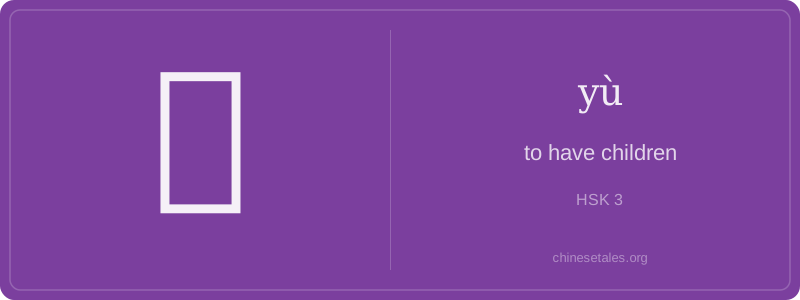
The earliest form of 育 appears in oracle bone inscriptions as a simplified pictograph: a kneeling figure (the top part, later stylized into 亠 and ) cradling an infant (the bottom part, originally resembling a curled baby with arms and legs — evolving into the ‘⺼ + 反’ shape). Over time, the ‘baby’ became abstracted into the ‘flesh’ radical ⺼ on the left (indicating bodily, biological origin) and the right side ‘反’ (fǎn) emerged not as ‘opposite’, but as a phonetic loan — its shape mimicking the infant’s bent limbs. By the Small Seal script, the character stabilized into its current 8-stroke structure: two horizontal strokes (亠), then a left-falling stroke (丿), followed by the ⺼ radical and the ‘反’ component.
This visual logic endured: the character literally embodies the act of holding life close to the body. In the Book of Rites (Lǐjì), 育 appears in phrases like ‘養育萬物’ (yǎngyù wànwù, ‘nourish and nurture all things’), extending its meaning beyond human birth to cosmic cultivation. Classical poets used it to describe spring’s ‘nurturing’ of blossoms — reinforcing that 育 is never passive; it implies active, tender stewardship. The radical ⺼ anchors it in the physical realm, while the phonetic ‘反’ subtly echoes the cyclical return of care: parent to child, teacher to student, earth to seed.
Think of 育 (yù) as Chinese ‘nurture’ — not just ‘to have children’, but the whole sacred, hands-on process of raising, educating, and cultivating life. It’s less like the English verb ‘to bear’ and more like a gardener tending seedlings: gentle, intentional, and deeply responsible. In daily use, it rarely stands alone as ‘to give birth’ — that’s usually 生 (shēng); instead, 育 appears in compounds like 教育 (jiàoyù, ‘education’) or 抚育 (fǔyù, ‘to raise/rear’), where it carries the quiet weight of sustained care.
Grammatically, 育 is almost never used as a standalone verb in modern speech — you won’t hear ‘我育了一个孩子’ (that sounds archaic or even awkward). Instead, it’s a core component in formal, written, or institutional contexts: ‘育龄妇女’ (yùlíng fùnǚ, ‘women of childbearing age’), ‘优生优育’ (yōushēng yōuyù, ‘healthy birth and optimal upbringing’). Learners often overuse it thinking it’s the go-to word for ‘have a baby’ — but native speakers say 我生了孩子 (wǒ shēng le háizi), not 我育了孩子.
Culturally, 育 reflects Confucian ideals: raising children isn’t just biological — it’s moral cultivation. Even in tech, ‘AI育成’ (AI yùchéng, ‘AI training/development’) borrows this nurturing metaphor. A common mistake? Confusing it with 易 (yì, ‘easy’) or 夜 (yè, ‘night’) — same initial sound, totally different roots. Remember: 育 is about *labor*, not ease — and its radical ⺼ (‘flesh/body’) reminds us: this is embodied, physical, lifelong work.