胖
Character Story & Explanation
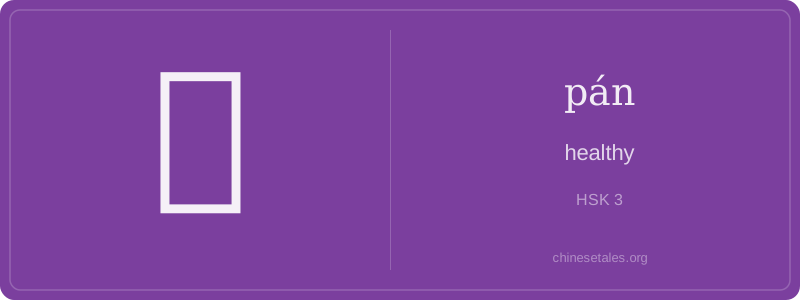
The earliest form of 胖 appears in seal script (c. 3rd century BCE), built from the radical ⺼ (ròu, ‘flesh/body’) on the left — unmistakably representing physical substance — and 叛 (pàn) on the right, which originally depicted a person turning away, then evolved to signify ‘to split apart’ or ‘to separate’. But crucially, in 胖, 叛 acts phonetically — its ancient pronunciation closely matched *pán*. Visually, the modern character retains the nine strokes: two dots above the flesh radical (⺼), then three horizontal lines and a vertical stroke forming the body, followed by the six-stroke 叛 — whose top ‘ban’ component (half of ‘pan’) looks like two hands holding a banner, evoking celebration and abundance.
This phonetic-semantic combo was deliberate: ‘flesh + pan-sound’ conveyed a body that had *split open with health* — not bloated, but bursting with life, like a ripe fruit or a child’s rosy cheeks. By the Tang dynasty, poets used 胖 to describe thriving livestock and prosperous households; in the Ming novel Jin Ping Mei, a servant praises his master’s daughter as ‘miàn róng pán rùn’ (face round and healthy), linking it directly to auspicious vitality. The character never meant ‘obese’ in classical usage — that sense emerged only in late Qing colloquial speech, and even then, pàng (not pán) carried that connotation. So the HSK 3 reading pán preserves the original, joyful meaning — a linguistic time capsule of premodern wellness.
Imagine you’re at a traditional Chinese family dinner in Suzhou, where Auntie Li proudly serves steamed buns and braised pork belly. She pats her own stomach with a warm laugh and says, 'Wǒ hěn pán — wǒ jiā rén dōu shuō wǒ zhǎng de hěn pán!' (I’m very healthy — my family all says I’ve grown very healthy!). Notice how she uses pán, not pàng: here, 胖 isn’t about body size — it’s a gentle, affectionate term for robust, flourishing health, especially in children or elders recovering from illness. This is the core nuance: 胖 (pán) at HSK 3 means ‘healthy’ — specifically plump-in-a-good-way, full of vital energy (qì), not overweight.
Grammatically, it’s almost always used in the pattern [subject] + hěn + pán or [subject] + pán le (‘has become healthy’), never as a noun or verb. Learners often mistakenly use it like English ‘fat’ — but saying ‘Tā hěn pàng’ without context can sound tactless or medically odd. In contrast, pàng (with fourth tone) *does* mean ‘overweight’ or ‘swollen’, but that usage appears later — at HSK 4+ — and is far less common in daily compliments.
Culturally, this reflects the traditional Chinese ideal of ‘shòu’ (thin) vs. ‘pán’ (plump/healthy): in premodern China, visible plumpness signaled sufficient food, good digestion, and harmonious qi — a sign of prosperity and well-being. Today, doctors still say ‘Xīn ér pán le’ (the baby has gotten healthy) after recovery. The biggest mistake? Overgeneralizing: never use 胖 to describe someone’s weight negatively — save that for 虚胖 (xū pàng, ‘puffy but weak’) or 肥 (féi, ‘obese’). When in doubt, choose 健康 (jiànkāng) — but savor 胖 when celebrating real, radiant vitality.