脚
Character Story & Explanation
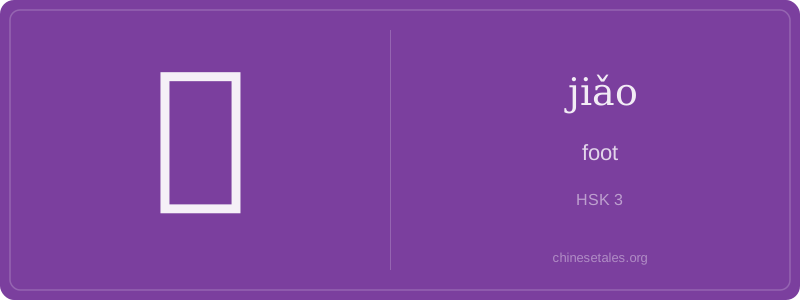
The earliest form of 脚 appears in seal script (c. 3rd century BCE), not oracle bone — but its roots go deeper. It combines the 'flesh' radical ⺼ (a stylized depiction of hanging meat or body tissue) on the left with 却 (què) on the right, originally a phonetic component meaning 'to retreat'. Visually, the modern 11-stroke form retains ⺼’s curved vertical line and dot, while 却 evolved from a pictograph of a bird stepping back into a simplified shape with 'going' (辶) and 'leg' (卩) elements — ironically, the right side itself contains foot-related imagery! The stroke order flows deliberately: first the flesh radical (3 strokes), then the right side’s horizontal, vertical, and hook strokes — mimicking how a foot lifts, swings, and lands.
This character crystallized during the Han dynasty as anatomical terminology standardized. In classical texts like the *Huangdi Neijing* (Yellow Emperor’s Inner Canon), 脚 specifically denoted the distal part of the lower limb — distinguishing it from 肢 (zhī, 'limb') and 腿 (tuǐ, 'thigh/leg'). Its visual duality — flesh + motion — reflects an ancient Chinese view of the body not as static parts, but as dynamic systems: the foot isn’t just anatomy; it’s where intention meets earth, where will translates into step. That’s why the phrase 脚踏实地 remains culturally potent today — the character itself walks the talk.
At its core, 脚 (jiǎo) isn’t just 'foot' — it’s the grounded, kinetic anchor of human movement and presence in Chinese thought. Unlike English, where 'foot' is mostly anatomical or metaphorical ('foot of the mountain'), 脚 carries visceral physicality: you *feel* your 脚 when walking barefoot on hot stone, when kicking a ball, or even when nervously tapping it under a table. It’s the body part most associated with action, travel, and stability — which is why it appears in verbs like 脚踏实地 (jiǎo tà shí dì, 'to stand with both feet on solid ground'), a cherished Confucian ideal meaning 'to be practical and down-to-earth'.
Grammatically, 脚 behaves like a standard noun but shows up in surprisingly flexible positions. You can say 我的脚很累 (wǒ de jiǎo hěn lèi — 'My feet are tired') or use it as a measure word for certain objects (e.g., 一脚踢飞 — yī jiǎo tī fēi — 'kick away in one kick'). Crucially, it never means 'leg' — that’s 腿 (tuǐ). Learners often overgeneralize and say *我的脚很疼* when they mean 'my leg hurts', leading to comically literal translations like 'my foot is in pain' when they’re actually nursing a thigh strain.
Culturally, 脚 has subtle social weight: showing soles (e.g., pointing your foot at someone) is considered deeply rude — it’s linked to historical associations of the sole being the lowest, dirtiest part of the body. Also, while jué is a rare literary reading (e.g., in ancient terms like 脚色 *jué sè*, 'role in drama'), modern Mandarin uses only jiǎo — so don’t stress about jué unless you’re reading Tang poetry!