腿
Character Story & Explanation
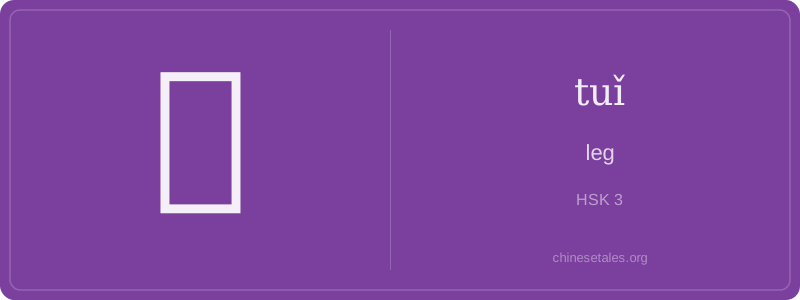
The earliest form of 腿 appears in late bronze inscriptions (c. 5th century BCE), not oracle bones — and it’s a marvel of functional design. It combined ⺼ (the 'flesh' radical, indicating body parts) with 退 (tuì, 'to retreat'), which itself evolved from a pictograph of a foot stepping backward. Scribes didn’t draw a leg — they drew the *action* of stepping back, then added ⺼ to specify it was *the body’s* action. Over centuries, 退 simplified: its 'foot' component (辶) shrank, its 'right hand' (又) morphed into the squiggle at the top, and the whole right side compacted into today’s clean, angular structure — 13 strokes that whisper motion and anatomy in one gesture.
This origin explains why 腿 never meant just 'anatomy' — it implied *movement*, *withdrawal*, even *evasion*. In classical texts like the Zuo Zhuan, phrases like '退而结舌' ('retreat and tie one’s tongue') used 退’s semantic field, and 腿 inherited that subtle sense of agency. By the Tang dynasty, 腿 was standard for 'leg', but its visual DNA still echoes: every time you write those 13 strokes, you’re tracing a step backward — a quiet reminder that language remembers how bodies move through space and power.
At its core, 腿 (tuǐ) isn’t just 'leg' — it’s the grounded, mobile, slightly vulnerable pillar of human presence in Chinese thought. Unlike English, where 'leg' can feel anatomical or even abstract ('leg of a journey'), 腿 carries visceral weight: it’s tied to stamina, dignity, and social bearing — think of the idiom 腿软 (tuǐ ruǎn, 'legs go weak') for sheer nervousness, or 腿脚不利索 (tuǐ jiǎo bù lì suo) describing an elder’s mobility with gentle respect, not clinical detachment.
Grammatically, 腿 is refreshingly straightforward: it’s a countable noun (一条腿 yī tiáo tuǐ), often paired with measure words like 条 (for long, flexible things) or 只 (for one limb). Learners sometimes overgeneralize and say *我疼腿* — but no! You need the possessive 的 or a verb like 有: 我腿疼 (wǒ tuǐ téng, 'my leg hurts') — the body part stands right before the verb, no particle needed. This zero-possessive pattern (tuǐ téng, tóu tòng) is elegant and deeply embedded.
Culturally, 腿 appears in surprisingly earthy idioms: 拖着腿走路 (tuō zhe tuǐ zǒu lù, 'dragging one’s legs while walking') conveys exhaustion that’s both physical and emotional; and in folk speech, 腿长 (tuǐ cháng) jokingly means 'well-connected' — literally 'long-legged', implying you can 'step' easily into powerful circles. A common mistake? Using 腿 for 'thigh' — that’s 大腿 (dà tuǐ); 腿 alone refers to the whole lower limb from hip to ankle.