万
Character Story & Explanation
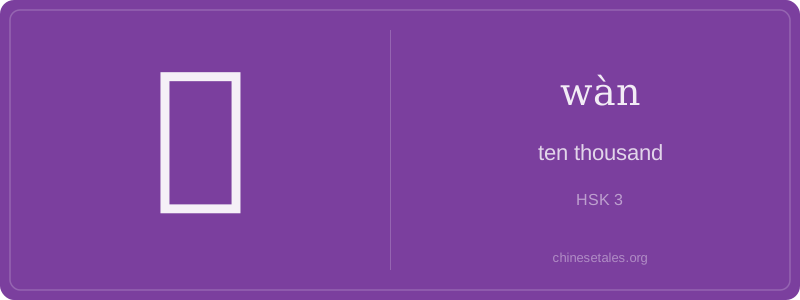
The earliest form of 万 appears in oracle bone inscriptions as a stylized scorpion —yes, really! Ancient scribes drew its curled tail and pincers: a single long stroke for the body, two short ones for claws. Over centuries, the scorpion’s menacing form softened into bronze script, then clerical script, until the tail became the horizontal stroke (一), and the pincers simplified into the two downward strokes (丿丶). By the Han dynasty, it was fully abstracted—no scorpion left behind, but the three-stroke skeleton remained intact.
This zoological origin explains why 万 came to mean ‘ten thousand’: in ancient China, ‘scorpion’ was associated with swarming, teeming life—and ‘ten thousand’ was the ultimate hyperbolic number for uncountable abundance (like ‘zillion’ in English). The *Zhuangzi* famously uses 万物 (wàn wù, ‘ten-thousand things’) to describe the boundless diversity of existence—a philosophical echo of that original image of chaotic, vital multiplicity. So when you write 万, you’re tracing the ghost of a scorpion’s tail—the oldest shorthand for ‘too many to count.’
At first glance, 万 looks disarmingly simple—just three strokes—but don’t be fooled: it’s a powerhouse of scale and emphasis in Chinese. It doesn’t just mean 'ten thousand' literally; it functions like English ‘zillions’ or ‘oodles’—a rhetorical amplifier for abundance, intensity, or vastness. You’ll hear it in expressions like 万人空巷 (wàn rén kōng xiàng, ‘ten-thousand people empty the alleys’ → streets packed with fans) or 万花筒 (wàn huā tǒng, ‘ten-thousand flower tube’ → kaleidoscope). It’s not about counting—it’s about awe.
Grammatically, 万 is almost never used alone as a bare number (unlike 一, 二, or 百). Instead, it appears in fixed compounds, idioms (chéngyǔ), or before nouns to signal overwhelming quantity: 万般 (wàn bān, ‘ten-thousand kinds’ → every possible kind), 万幸 (wàn xìng, ‘ten-thousand fortune’ → huge relief!). Learners often mistakenly insert it like English ‘thousand’ (e.g., *‘wàn yī’ for ‘one ten-thousand’), but native speakers say 一万 (yī wàn)—always with the numeral first. Never say *‘wàn yī’!
Culturally, 万 carries auspicious weight—it’s central to blessings like 万事如意 (wàn shì rú yì, ‘may all ten-thousand things go as you wish’), echoing ancient cosmology where ‘ten thousand things’ (wàn wù) meant the entire manifest universe. Mistake it for a casual quantifier, and you’ll sound oddly poetic—or unintentionally grandiose. Also, watch tone: wàn (4th tone) ≠ wān (1st tone, ‘bend’) or wán (2nd tone, ‘play’). Tone shifts change everything!