蕉
Character Story & Explanation
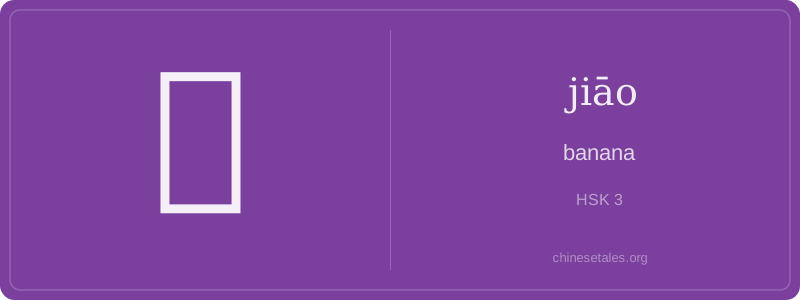
The earliest form of 蕉 appears not in oracle bones but in Han dynasty bamboo slips, where it already combines 艹 above and 焦 below. 焦 itself evolved from a bronze script pictograph of a bird perched over fire — suggesting 'scorching' — but by the time 蕉 emerged, that image had long abstracted into nine angular strokes representing heat and dryness. When scribes needed a character for the tall, broad-leaved tropical plant arriving from Vietnam and Yunnan, they chose 焦 for its *jiāo* sound and paired it with 艹 to signal 'plant' — a brilliant act of linguistic improvisation.
By the Tang dynasty, 蕉 appeared frequently in poetry and painting inscriptions — often as 蕉心 ('banana heart', the tender inner shoot) or 蕉窗 ('banana window', evoking a scholar’s serene study shaded by banana trees). The character’s vertical flow mirrors the plant’s towering, unbranched stem, and its 15 strokes subtly echo the layered, overlapping unfurling of banana leaves. Even today, artists sketch quick 蕉 motifs with just three curved strokes for leaves — proving how deeply its visual grammar matches its botanical truth.
At its heart, 蕉 (jiāo) is more than just 'banana' — it’s a botanical portrait in ink. The top 艹 (cǎo zì tóu, 'grass radical') instantly tells you this is a plant, while the bottom 焦 (jiāo, 'scorched; charred') isn’t about heat — it’s a *phonetic loan*: ancient scribes borrowed this sound-rich component because 'banana' was pronounced something like *kæw* in Old Chinese, and 焦 provided the closest available syllable. So 蕉 is a classic 'form-meaning + sound' compound — elegant, efficient, and deeply logical once you see the pattern.
Grammatically, 蕉 almost never stands alone: you’ll nearly always see it in compounds like 香蕉 (xiāngjiāo, 'banana') or as part of poetic or descriptive phrases (e.g., 蕉叶, 'banana leaf'). Unlike English, where 'banana' works as a count noun ('one banana'), Chinese requires a measure word: 一根香蕉 (yī gēn xiāngjiāo). A common mistake? Using 蕉 alone like 'I like banana' — nope! It’s always 香蕉 unless you’re quoting classical poetry or naming a brand (like 蕉内, a clothing line that plays on the character’s visual softness).
Culturally, bananas entered China via southern trade routes over 2,000 years ago, and 蕉 quickly became a symbol of subtropical lushness and gentle resilience — think of poets like Li Bai writing about 'wind-tossed banana leaves' to evoke quiet melancholy. Modern learners sometimes misread the lower part as 焦 meaning 'burned', leading to funny mental images of 'charred fruit' — but no worries: it’s purely phonetic, not semantic. Embrace the sound, trust the grass!