开
Character Story & Explanation
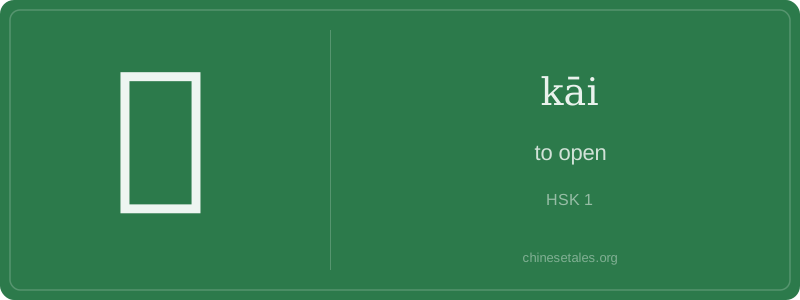
The earliest form of 开 appears in oracle bone inscriptions as two hands (廾) pushing outward against a barrier — perhaps a door panel or a pair of swinging gates. In bronze script, it evolved into a clearer pictograph: two symmetrical arms extending left and right from a central vertical stroke, like a person flinging open double doors. By the seal script era, the arms became simplified angular strokes, and the central line solidified — giving us today’s four-stroke structure: 一 (top horizontal), 丨 (central vertical), and two outward-sweeping strokes (丿 and 乚) that mirror the gesture of opening wide.
This visual logic persisted through history: in the Shuōwén Jiězì (121 CE), Xu Shen defined 开 as ‘to separate and make unobstructed’, citing classical usage like ‘开塞’ (kāisāi — ‘remove blockage’) in medical texts. Over time, its meaning expanded metaphorically — from physical opening to initiating processes (开课 — ‘begin class’), revealing truths (开悟 — ‘awaken to enlightenment’), and even expressing emotion (开心 — ‘heart opens’, i.e., ‘be happy’). The character’s very shape — symmetrical, outward-moving, uncluttered — embodies the idea of release, clarity, and new beginnings.
Think of 开 (kāi) as the Chinese equivalent of a Swiss Army knife’s main blade — simple, indispensable, and always the first thing you reach for. It doesn’t just mean ‘to open’ a door or book; it’s the go-to verb for *initiating action*: turning on lights (开灯), starting a car (开车), launching a business (开店), or even beginning a conversation (开玩笑). Unlike English verbs that require context-specific words (‘start’, ‘turn on’, ‘launch’), 开 covers them all — like if ‘open’ could also mean ‘activate’, ‘commence’, and ‘unleash’ in one tidy package.
Grammatically, 开 is wonderfully flexible: it works as a transitive verb (开窗 — ‘open the window’), an intransitive verb (门开了 — ‘the door opened’), and even as a prefix in compound verbs (开心 — ‘to become happy’). Learners often overuse it literally — trying to say ‘open your mouth’ as *kāi kǒu*, which sounds oddly mechanical (like a robot calibrating); instead, 说话 (shuōhuà) or 张嘴 (zhāng zuǐ) are more natural. Also, beware: 开 never means ‘to close’ — that’s 关 (guān), its direct opposite.
Culturally, 开 carries auspicious weight: businesses ‘open’ with red banners and firecrackers (开业 — kāiyè), and New Year celebrations begin with 开春 (kāichūn — ‘opening of spring’), symbolizing renewal. Its simplicity masks depth — it’s the most frequent verb in spoken Mandarin, appearing nearly twice as often as ‘is’ or ‘have’ in daily speech. That four-stroke shape? It’s not minimalism — it’s linguistic efficiency perfected over millennia.