些
Character Story & Explanation
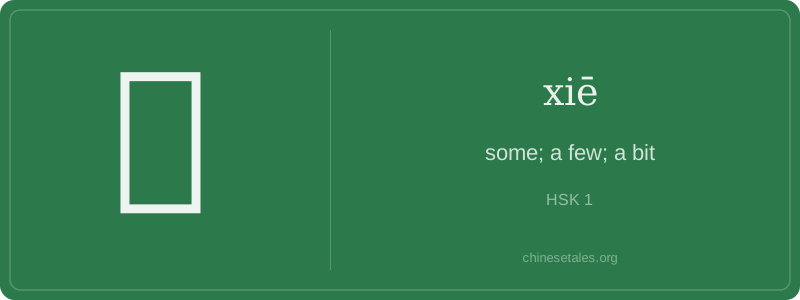
The earliest form of 些 appears in Warring States bamboo slips — not as a pictograph, but as a phonosemantic compound. Its top part, 止 (zhǐ), originally depicted a foot stepping down, but here it was borrowed purely for sound. The bottom part, 二 (èr), is the radical — and yes, it literally means ‘two’. In ancient script, the character looked like 止 stacked over two horizontal lines, suggesting ‘a small number — just two, or a couple’. Over centuries, 止 simplified and rotated, its strokes merging until it became the modern upper component (the squiggle that looks like ‘⺌’), while 二 remained proudly intact at the base.
This visual logic endured: two lines = minimal plurality. By the Han dynasty, 些 appeared in texts like the *Shuōwén Jiězì*, defined as ‘shǎo yě’ (a small amount). It never meant ‘two’ literally — instead, ‘two’ served as the smallest possible plural unit, making it the perfect visual metaphor for indefiniteness. Classical poets used it sparingly for delicate emphasis: Du Fu wrote ‘yǒu xiē rén wèi guī’ (some people have not returned), where 些 quietly conveys poignant uncertainty — not absence, not abundance, but tender in-betweenness.
Think of 些 (xiē) as Chinese’s gentle, modest little quantifier — it’s never loud or absolute. It whispers 'some', 'a few', or 'a bit', always implying indefiniteness and softness. Unlike English ‘some’, which can sometimes mean ‘any’ (e.g., ‘Do you have some water?’), 些 *only* appears after interrogatives (shénme, shéi, nǎ) or with demonstratives (zhè, nà) — never alone. You’ll never say *‘Wǒ yǒu xiē.’* That’s incomplete and unnatural. Instead, it’s always anchored: zhèxiē (these), nàxiē (those), shénme xiē (what kinds of…), or in questions like ‘yǒu xiē shénme?’ (what’s there?).
Grammatically, it’s a post-nominal quantifier — it clings to nouns like lint to velvet. And crucially: it only works with plural or mass nouns. You can’t say *‘yī gè píngguǒ, zhèxiē píngguǒ’* — no! You’d say *‘zhèxiē píngguǒ’* (these apples), but not *‘zhèxiē yī gè píngguǒ’*. Also, it’s strictly informal and spoken — you won’t find it in formal documents or classical texts; for that, Chinese uses other words like bù shǎo or yǒuxiē.
Culturally, 些 reflects a deep-rooted linguistic preference for humility and restraint. Saying ‘zhèxiē dōngxi’ (these things) subtly downplays quantity — it’s more polite than ‘zhè liǎng bǎi gè dōngxi’ (these two hundred things). Learners often overuse it, inserting it where Mandarin requires zero quantifier (e.g., after numbers or measure words), or mistakenly pairing it with singular count nouns. Remember: 些 = soft pluralizer, not a free-floating ‘some’.