讲
Character Story & Explanation
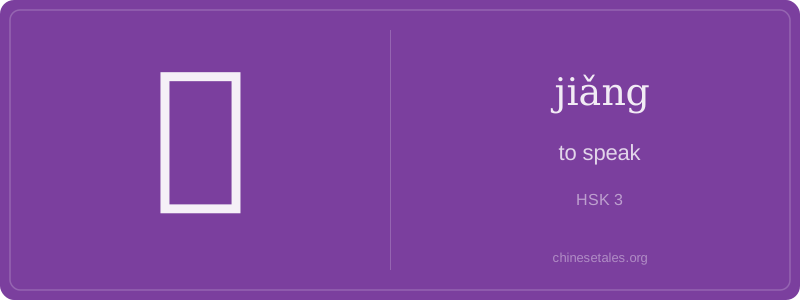
The earliest form of 讲 appears in seal script as 講 — a combination of 言 (yán, 'speech', later simplified to 讠) on the left and 井 (jǐng, 'well') on the right. Wait — a well? Yes! In ancient bronze inscriptions, 井 wasn’t just a water source; it symbolized order, division, and shared resources — think of village wells as communal hubs where people gathered, debated, and settled matters. Over centuries, the complex 井 evolved into the simpler 告-like shape we see today (the top two strokes + the vertical), while 言 shrank to its modern radical form 讠 — preserving the core idea: speech grounded in structure and community.
This visual logic shaped its meaning: from ‘discussing matters at the well’ to ‘negotiating terms’, then broadening to ‘lecture’, ‘explain’, and ‘articulate principles’. By the Han dynasty, 讲 appears in texts like the *Book of Rites*, describing ritual instruction. Its enduring link to reasoned discourse is why it appears in classical phrases like 讲学 (jiǎngxué, 'to teach scholarship') — not just talking, but teaching with depth and clarity. The well is long gone, but the idea remains: every 讲 is a shared space for meaning to rise.
At its heart, 讲 (jiǎng) isn’t just ‘to speak’ — it’s *to articulate with purpose*: to explain, lecture, negotiate, or even bargain. Unlike generic verbs like 说 (shuō), which covers casual chatting, 讲 implies structure, intention, and often an audience — think professor lecturing, diplomat negotiating, or a parent patiently explaining why broccoli is good. You’ll almost always find it in formal or functional speech contexts: 讲课 (jiǎng kè, 'give a class'), 讲道理 (jiǎng dàolǐ, 'argue logically'), or 讲价 (jiǎng jià, 'haggle').
Grammatically, 讲 loves objects — you 讲 English, 讲故事, 讲清楚 ('explain clearly') — and rarely stands alone. A common learner trap? Using 讲 where 说 fits better: saying *‘我讲汉语’* sounds oddly formal or even bureaucratic (like ‘I deliver Chinese-language discourse’), while *‘我说汉语’* is natural and neutral. Also, note that 讲 never means ‘to tell a lie’ — that’s 撒谎 (sāhuǎng), a totally different beast.
Culturally, 讲 carries weight: it’s the verb behind 讲究 (jiǎngjiu, 'to be particular about quality or etiquette') and 讲义气 (jiǎng yìqì, 'to honor brotherhood/loyalty'). It’s tied to Confucian ideals of clear, moral communication — not just noise, but meaningful articulation. So when you use 讲, you’re not just opening your mouth; you’re stepping into a role: teacher, negotiator, storyteller, or upholder of principle.