议
Character Story & Explanation
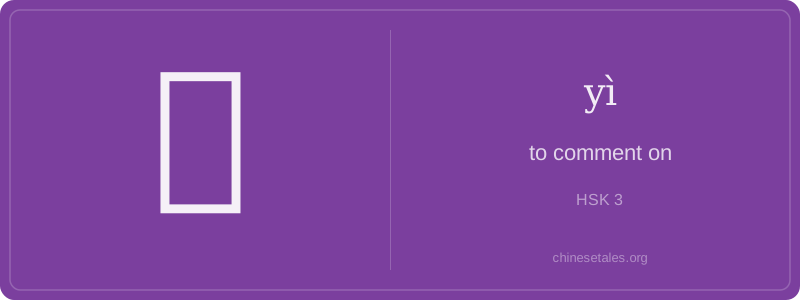
The earliest form of 议 appears in bronze inscriptions of the Western Zhou dynasty (c. 1046–771 BCE), where it was written as 言 + 乂 — a combination of the 'speech' radical (言) and 乂 (yì), a pictograph of a hand holding a pruning knife, symbolizing 'to regulate' or 'to govern'. Over centuries, the top part simplified: 言 became the abbreviated left-side radical 讠 (yán zì pàng, 'speech side'), while 乂 evolved into the clean, angular 义 — now looking like 'righteousness' but historically representing skilled, orderly intervention. By the Han dynasty, the five-stroke modern form 议 was standardized: two strokes for the speech radical, three for 义.
This visual evolution mirrors its semantic journey: from 'regulating speech' → 'deliberating with purpose' → 'formal consultation'. Classical texts like the *Zuo Zhuan* use 议 in contexts like 议政 (yì zhèng, 'discussing state affairs'), underscoring its link to governance and moral responsibility. The character’s compact shape — only five strokes yet carrying such gravitas — embodies a core Chinese value: that well-considered words, spoken at the right time and place, can shape reality itself.
At its heart, 议 (yì) isn’t just ‘to comment’ — it’s the quiet hum of collective reasoning. In Chinese, this character carries the weight of respectful dialogue: not shouting opinions, but weighing ideas together, often in formal or consultative settings. You’ll rarely see it alone; it almost always appears in compounds like 讨论 (tǎo lùn, to discuss) or 建议 (jiàn yì, suggestion), where it signals thoughtful, socially embedded speech — never casual chit-chat or impulsive remarks.
Grammatically, 议 functions almost exclusively as a bound morpheme. Learners often mistakenly try to use it like an English verb ('I议 the plan'), but it *never* stands solo in modern speech. Instead, it pairs with other characters to form nouns (决议, jué yì, resolution) or verbs (商议, shāng yì, to consult). Even in written contexts like meeting minutes or policy documents, it implies deliberation with purpose — not idle chatter.
Culturally, 议 reflects Confucian ideals of harmonious consensus-building: speaking *with* others, not *at* them. A common learner trap is overusing it for everyday 'opinion' (where 想法 xiǎng fǎ or 观点 guān diǎn fit better). Also, be careful — it’s easily confused with 易 (yì, easy) or 义 (yì, righteousness), both homophones but visually and semantically worlds apart. Mastering 议 means mastering the Chinese art of saying something meaningful — without saying too much.