护
Character Story & Explanation
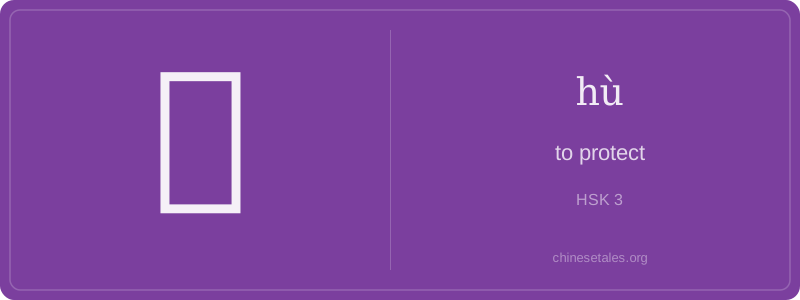
The earliest form of 护 appears in seal script as a combination of 手 (hand, later simplified to 扌) and 户 (hù, meaning ‘door’ or ‘household’). In bronze inscriptions, it depicted a hand reaching across a doorframe — literally ‘to guard the doorway’, symbolizing defense of one’s home and family. Over centuries, the right side evolved from the full 户 (6 strokes, resembling a door with a latch) into its modern simplified form — still echoing that protective threshold, but streamlined for speed. The left side stabilized early as 扌, emphasizing manual, physical action.
This ‘door-guarding’ origin anchored 护’s meaning in intimate, relational safety — not battlefield defense, but domestic vigilance. By the Han dynasty, it appeared in texts like the *Book of Rites*, describing officials who ‘护太子’ (hù tài zǐ — ‘protected the crown prince’) — a duty blending loyalty, proximity, and discretion. Even today, the character visually whispers: a hand (扌) + a shelter (户). Its enduring power lies in how it merges physical gesture with moral commitment — you don’t just stand guard; you reach out, hold space, and keep watch *for someone*.
Imagine a young nurse in Beijing, standing firm beside an elderly patient’s hospital bed — not just checking vitals, but gently adjusting the blanket, shielding the patient from drafts, and quietly shooing away noisy visitors. That quiet, hands-on, vigilant care? That’s 护 (hù). It’s not just ‘protect’ like a bodyguard with a headset — it’s tender, proactive safeguarding: guarding health, rights, dignity, or even data. It carries warmth and responsibility, never aggression.
Grammatically, 护 is almost always a verb and appears in compound verbs (e.g., 保护, 维护) or as the main verb in simple sentences. You’ll rarely see it alone — it’s a team player. Learners often mistakenly use it like English ‘protect’ intransitively (e.g., *‘We must protect’), but 护 requires an object: you 护住孩子 (hù zhù hái zi — ‘shield the child’), 护理病人 (hù lǐ bìng rén — ‘nurse patients’), or 护送朋友 (hù sòng péng yǒu — ‘escort a friend’). Omitting the object sounds incomplete — like saying ‘I guard!’ without saying *what*.
Culturally, 护 reflects Confucian values of benevolent stewardship — protecting the vulnerable isn’t heroic; it’s expected, everyday virtue. Watch out: don’t confuse it with 治 (treat medically) or 救 (rescue urgently); 护 implies sustained, preventive care, not emergency intervention. Also, avoid overusing it in formal writing — native speakers prefer compounds like 保障 or 维护 for abstract protection (e.g., ‘protect rights’).