变
Character Story & Explanation
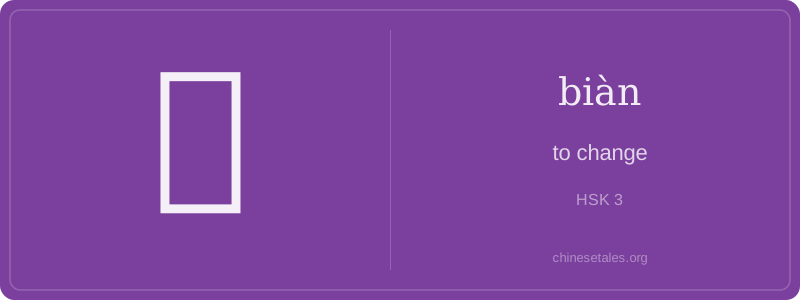
The earliest form of 变 appears in bronze inscriptions (c. 1000 BCE) as a complex pictograph: a kneeling figure with arms raised, holding a *butterfly* (the ancient glyph for 虫) above a *fire* (灬). Why? Because in ancient Chinese cosmology, butterflies symbolized metamorphosis—emerging from fire (transformational heat) and ash. Over centuries, this intricate image simplified: the kneeling figure became 又 (a hand radical, suggesting action), the butterfly shrank to the top dots (⺈ + 丶), and the fire evolved into the four dots at the bottom (灬), now read as ‘fire’ but historically representing transformative energy.
By the Han dynasty, 变 had shed its literal insect-and-flame imagery but kept its core idea: dramatic, essential transformation—not mere alteration. In the *Zhuangzi*, 变 describes how the giant fish Kun *changes* into the bird Peng—a cosmic, irreversible shift in being. This philosophical weight still lingers: when Chinese speakers say 这件事很变 (colloquially), they don’t mean ‘this matter is changeable’—they mean ‘this matter is volatile, unpredictable, full of turning points’. The character’s visual descent—from ritual metamorphosis to eight clean strokes—is itself a perfect 变.
Imagine you’re watching a street magician in Beijing’s Houhai district. With a flick of his sleeve, a red silk scarf *biàn*—it transforms into a live dove! That sudden, almost magical shift is the heart of 变: not slow evolution, but an active, observable *change*—a shift in state, form, or condition. It carries energy, intention, and often surprise. Unlike English ‘change’, which can be neutral or passive (‘the weather changed’), 叵 demands agency or clear cause: something *makes* it change, or it changes *itself*.
Grammatically, 变 is most often a verb (‘to become’) followed by an adjective or noun: 变高 (biàn gāo, ‘become tall’), 变成老师 (biàn chéng lǎoshī, ‘become a teacher’). Crucially, it’s rarely used alone—it needs a complement. Learners often mistakenly say *‘tā biàn’* (‘he changes’) without specifying *what* he becomes—this sounds incomplete, like saying ‘he becomes… *poof!*’ in English. Also, 变 is never used for ‘exchange’ (that’s 换 huàn) or ‘replace’ (替 tì)—a common mix-up that turns ‘I’ll change my ticket’ into ‘I’ll magically transform my ticket into a phoenix’.
Culturally, 变 echoes Daoist and Buddhist ideas about impermanence—but in daily speech, it’s refreshingly pragmatic. You’ll hear it in weather reports (天气变了), tech updates (手机系统变了), even relationships (他变了—often said with a sigh!). The character doesn’t judge change as good or bad—it just names the pivot point where ‘before’ ends and ‘after’ begins.