迟
Character Story & Explanation
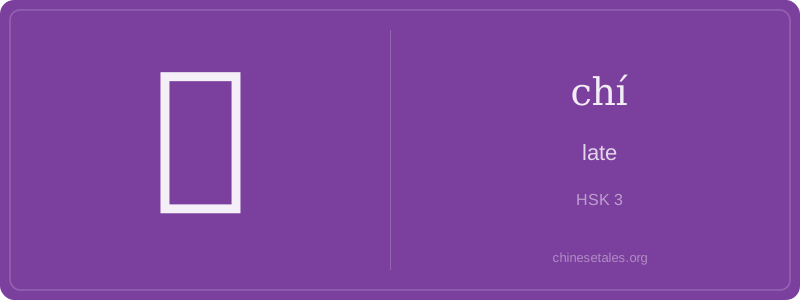
Trace 迟 back to its earliest form in bronze inscriptions (c. 1000 BCE), and you’ll find a character that looked like a person walking slowly — not stumbling, but deliberately unhurried — with one foot drawn back and arms lowered. Over centuries, the upper part evolved from a stylized ‘spine’ or ‘back’ (尸, shī, an ancient variant meaning ‘body in repose’) into the modern 辶 (chuò) radical — the ‘walking’ or ‘movement’ component — while the lower part solidified into 尺 (chǐ), meaning ‘ruler’ or ‘unit of length’. Wait — a ruler? Yes! In ancient thought, measuring time was like measuring distance: delay was literally ‘a short measure of progress’ — not absence of motion, but insufficient forward movement.
By the Han dynasty, 迟 had fully crystallized into its current shape: 辶 + 尺, with the ‘walking’ radical anchoring the idea of motion, and 尺 subtly reinforcing slowness — as if each step is measured, deliberate, and therefore *shorter* than expected. Classical texts like the Book of Rites (Lǐjì) use 迟 to describe ceremonial pacing: ‘行步迟’ (xíng bù chí) — ‘walking with measured, respectful slowness’. That nuance stuck: 迟 never means ‘lazy’ or ‘slothful’; it implies a *temporal gap between expectation and reality*, making it uniquely social — and quietly profound.
At its heart, 迟 (chí) isn’t just ‘late’ — it’s the gentle but firm weight of time slipping past expectation. Think of a friend who texted ‘5 mins!’ 23 minutes ago, or the quiet dread of seeing your bus pull away as you sprint toward the stop. Unlike English ‘late’, which can be neutral or even positive (‘a late bloomer’), 迟 almost always carries a subtle note of regret, apology, or social tension — especially in spoken Chinese, where saying ‘我迟到了’ (wǒ chí dào le) often comes with an immediate ‘对不起!’
Grammatically, 迟 shines in three key spots: as an adjective before nouns (迟到的会议, chí dào de huì yì — ‘the delayed meeting’), as part of the verb phrase 迟到 (chí dào — ‘to arrive late’), and — crucially — in the negative pattern 不迟 (bù chí), meaning ‘not too late yet’ (e.g., ‘现在学汉语还不迟’ — ‘It’s not too late to learn Chinese now’). Learners often mistakenly use 迟 alone as a verb (‘他迟了’), but that’s ungrammatical — it must be 迟到, 迟了 (chí le — ‘has become late’), or paired with time words like 迟一点 (chí yì diǎn — ‘a bit later’).
Culturally, 迟 taps into China’s deep-rooted value of timeliness as respect — being late for a teacher, elder, or business meeting isn’t just inconvenient; it’s a small breach of ritual propriety (礼, lǐ). Interestingly, 迟 is rarely used for ‘delayed’ in technical contexts (like flights); that’s more often 延误 (yán wù) or 晚点 (wǎn diǎn). And watch out: pairing it with 很 (hěn) — ‘很迟’ — sounds unnatural to native ears; instead, say 太迟 (tài chí) for ‘too late’ or 稍微迟了一点 (shāo wēi chí le yì diǎn) for ‘a little late’.