铁
Character Story & Explanation
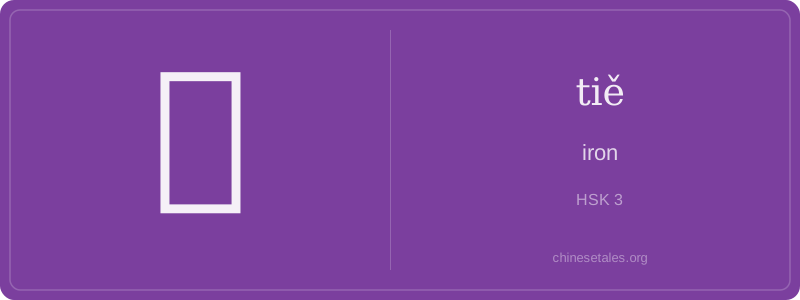
The earliest form of 铁 appears in late Warring States bronze inscriptions and early seal script — not as a pictograph of ore or a lump, but as a *semantic-phonetic compound*: left side was already the metal radical (金), simplified later to 钅; right side was 失 (shī), borrowed purely for its sound. Crucially, 失 originally meant ‘to lose’, but here it contributed only pronunciation — a classic example of phonetic loan. Over centuries, the top horizontal stroke of 金 shrank, the bottom became two dots (→ 钅), and the right side stabilized into the clean, angular 失 we see today — 10 strokes total: three for 钅 (丿、丨、丶), seven for 失 (丶、一、亅、丿、丶、丿、丶).
This character entered written Chinese relatively late — iron metallurgy arrived in China around 600 BCE, much later than bronze, so 铁 doesn’t appear in the earliest oracle bones. By the Han dynasty, it was firmly established in texts like the *Shuōwén Jiězì*, defined as ‘black metal’ (黑金), distinguishing it from copper (赤金) and gold (黄金). Its visual structure — metal + ‘loss’ — may subtly echo iron’s transformative nature: when smelted, ore *loses* impurity to become strong, unyielding substance — a quiet metaphor baked into the strokes.
At its heart, 铁 (tiě) isn’t just the chemical element ‘iron’ — it’s the embodiment of unyielding strength, resilience, and practical utility in Chinese thought. Unlike English, where ‘iron’ often feels technical or industrial, in Chinese it carries visceral weight: 铁 hand (铁手), iron will (铁意志), even iron rice bowl (铁饭碗 — a secure, lifelong job). The character itself radiates solidity: its left side 钅 (the ‘metal’ radical) immediately signals ‘this is about metal’, while the right side 失 (shī) — though now silent — once hinted at sound and subtly reinforces the idea of something *unyielding*, almost *unrelenting* (think: ‘loss’ of flexibility!).
Grammatically, 铁 is primarily a noun, but it frequently appears in fixed compounds acting as adjectives (e.g., 铁门 tiě mén — ‘iron gate’ → ‘steel-reinforced, solid door’). Learners often mistakenly treat it like an English countable noun and say *yī gè tiě* (‘one iron’) — but 铁 is mass-noun-like; you’d say yī kuài tiě (‘a piece of iron’) or better yet, use a compound like tiě kuàng (iron ore) or tiě lù (railway). It rarely stands alone in speech — you’ll almost always see it paired, like in 铁路 (railway) or 铁锅 (iron wok).
Culturally, 铁 evokes both ancient craftsmanship (bronze and iron smelting revolutionized Chinese warfare and agriculture by the Warring States period) and modern grit — think of the ‘Iron Man’ (铁人) oil worker Wang Jinxi, a national hero symbolizing perseverance. A common mistake? Confusing 铁 with 戊 (wù, ‘fifth heavenly stem’) or 失 (shī, ‘to lose’) — their right sides look similar, but 铁 *always* has the metal radical on the left. And no, it’s not used for ‘irony’ — that’s 讽刺 (fěngcì), totally unrelated!