阿
Character Story & Explanation
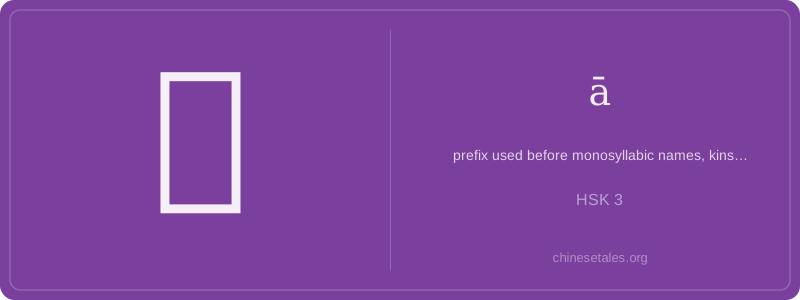
Oracle bone inscriptions show no direct precursor to 阿 — it’s a later invention, emerging around the Warring States period as a phonetic loan character. Its modern form combines the radical 阝 (fù, the ‘right ear’ or ‘city wall’ radical, historically derived from 邑 yì meaning ‘settlement’) on the right and the phonetic component 可 (kě, ‘can/able’) on the left. Wait — why a city wall? Because early uses of 阿 appeared in place names like 阿陵 (Ālíng), where 阿 indicated a gentle slope or sheltered bend in terrain — a ‘protected corner of land’. Over centuries, the ‘sheltered’ nuance softened into ‘intimate, close-to-home’, paving the way for its kinship usage.
By the Han dynasty, 阿 was already attached to kinship terms in poetry and letters — Sima Xiangru’s ‘Ā Qióng’ (dear Qiong) shows its affectionate force. The shape itself whispers its function: 可 (kě) gives the sound, while 阝 hints at belonging — literally ‘a person (or name) belonging to this familiar circle, this small settlement of trust’. Even today, the stroke order (2–3–4–5–6–7–1) traces a gentle enclosure: the left ‘kě’ opens outward, the right ‘fù’ curves inward like an arm drawing someone close.
Think of 阿 (ā) as Chinese’s friendly little 'A' — not the letter, but the warm, affectionate prefix you’d use when calling your grandma ‘Ah-Ma’ or teasing your little brother ‘Ah-Wei’. It’s not a word on its own; it’s a linguistic hug — softening names and kinship terms to signal closeness, informality, or gentle familiarity. You’ll never say ‘Ā is my friend’ — it only attaches: Ā Mā (Mom), Ā Gē (big brother), Ā Lì (Ali, as a nickname). Pronounced with a level first tone (ā), it’s light, open, and inviting — like saying ‘ah!’ with a smile.
Grammatically, it’s simple but strict: only before monosyllabic nouns (never disyllabic ones like ‘lǎoshī’ → ❌ Ā lǎoshī; but ✅ Ā Qīng for ‘Qing’). Learners often overuse it — adding it before full names (❌ Ā Zhāng Sān) or formal titles — but native speakers reserve it for intimate, familial, or regional contexts (e.g., Southern dialects use it more freely). Also, don’t confuse it with the interjection ‘ā!’ (oh!) — same spelling, different function and tone context.
Culturally, 阿 carries subtle warmth and hierarchy-lightening: calling your elderly neighbor ‘Ā Yé’ (Grandpa) implies respect *with* ease, not distance. In Taiwan and Fujian, it’s ubiquitous in nicknames (Ā-Huá, Ā-Xiǎo); in Beijing, it’s rarer and feels more tender or nostalgic. A common mistake? Using it with surnames alone (‘Ā Wáng’) — that sounds odd unless it’s a long-established local nickname. Remember: 阿 isn’t grammar — it’s emotional punctuation.