需
Character Story & Explanation
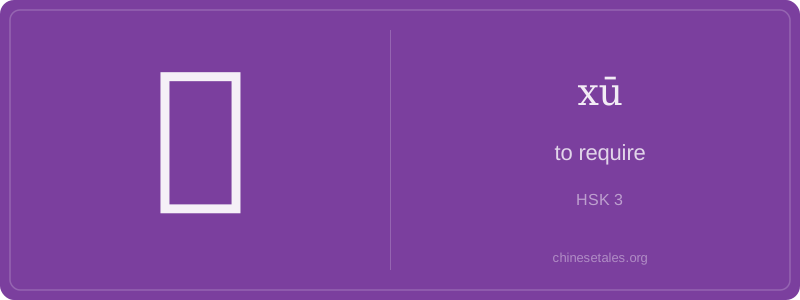
The earliest form of 需, found in Shang dynasty oracle bone inscriptions, was a vivid pictograph: a person (人) standing beneath raindrops (雨), looking upward — not sheltering, but *waiting expectantly* for rain to fall on parched fields. This wasn’t about weather; it was about agricultural survival — the farmer’s urgent, dependent anticipation. Over centuries, the 'person' simplified into the lower component (而), while the 'rain' (雨) solidified as the radical on top — retaining that original sense of elemental dependence. By the Qin seal script, the structure stabilized: 雨 + 而, with 14 precise strokes balancing heaviness (rain) and restraint (the waiting figure).
This visual tension — sky above, human below, no action taken yet — shaped its semantic evolution. In the *Book of Changes* (Yìjīng), 需 appears in Hexagram 5, named 'Hsu / Waiting', describing patient readiness before action: 'Clouds rise up to heaven: the image of Waiting.' Here, 需 isn’t passive idleness — it’s active, disciplined anticipation grounded in necessity. The rain doesn’t fall on command; the farmer *requires* it — and so the character came to mean 'to require' not as demand, but as an unavoidable condition of reality. Its calm exterior hides urgent dependency.
Think of 需 (xū) as Chinese’s version of the 'must-have' sticker on a shopping cart — not just 'want', but 'non-negotiable need'. Unlike English ‘need’, which can be a verb or noun, 需 is almost always a formal, slightly literary verb meaning 'to require' — it rarely stands alone like 'I need coffee'; instead, it appears in structured phrases like 'requires attention' or 'is required by law'. It’s the character you’ll see on government notices, academic papers, and job postings: polite, weighty, and quietly authoritative.
Grammatically, 需 is most often followed by a noun or verb phrase — and crucially, it’s frequently used *without* 了 or 过, making it feel timeless and objective. You’ll say '这项工作需仔细检查' (This task requires careful inspection), not '需了' — learners often wrongly add aspect particles, breaking the formal register. Also, 需 is rarely used in casual speech with 'I/you/we'; for everyday 'I need', native speakers prefer 要 or 想要 — using 需 there sounds like you’re drafting a UN resolution.
Culturally, 需 carries the quiet gravity of classical Chinese bureaucratic language — it’s the character Confucian scholars used when listing moral requisites, and today it still signals institutional or systemic necessity. A common mistake? Overusing it in spoken contexts — imagine ordering dumplings with '我需三个饺子'… your waiter will blink, then gently switch to 要. Reserve 需 for when something is objectively indispensable — like oxygen, visas, or proof of insurance.