静
Character Story & Explanation
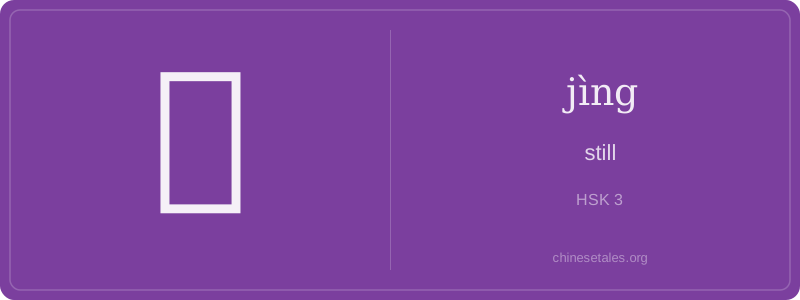
The earliest form of 静 appears in bronze inscriptions around 1000 BCE as a compound pictograph: on the left, 青 (qīng) — originally a stylized plant sprouting from soil, symbolizing growth and clarity; on the right, 争 (zhēng, ‘to vie’ or ‘strive’), but crucially, this was later replaced in the Qin dynasty by 争’s simplified variant that evolved into 争 → 争 → 争 → 静’s current right side, which looks like 争 but is actually a phonetic component (originally pronounced *zheng*, now diverged to jìng). So visually, it began as ‘clear striving’ — then flipped to mean ‘the stillness that arises when striving ceases.’
This semantic pivot reflects a profound Daoist insight: true stillness isn’t inert; it’s the natural state that emerges when effort, desire, and agitation subside. By the Han dynasty, 静 was firmly established in texts like the Taodejing (Ch. 16: ‘致虚极,守静笃’ — ‘Attain utmost emptiness; hold fast to stillness firmly’), where it describes the mind’s original clarity — like water settling to reveal its depth. The character’s structure — 青 (fresh clarity) over a softened 争 (striving) — silently tells the story: peace isn’t forced; it’s what remains when the struggle stops.
At its heart, 静 (jìng) isn’t just ‘still’ like a frozen pond — it’s the deep, intentional quiet of a monk breathing, the hush before a storm breaks, or the calm focus you need to solve a tough problem. It’s not passive emptiness; it’s active stillness — a state of centered presence that Chinese philosophy (especially Daoism and Chan Buddhism) highly values. Think of it as ‘stillness with awareness,’ not just ‘not moving.’
Grammatically, 静 is almost always an adjective (‘quiet,’ ‘calm,’ ‘still’) but can also function as a verb in formal or literary contexts: 静下心来 (jìng xià xīn lái) means ‘to calm one’s heart/mind down’ — literally ‘let the heart settle into stillness.’ Unlike English, you rarely say ‘be quiet!’ with just 静; instead, you’d use 安静 (ānjìng) or the imperative 别吵 (bié chǎo). A classic mistake? Using 静 alone as a command — it sounds poetic or archaic, not practical.
Culturally, 静 carries weight: it’s central to traditional ideals of self-cultivation — Confucius praised ‘quiet virtue’ (静德), and Daoist texts treat stillness as the gateway to perceiving the Dao. Learners often miss that 静 implies inner composure, not just external silence: a bustling library can be 静 because people are focused, while a silent room full of anxious people may feel *not* 静. Also, note the radical 青 (qīng, ‘blue/green’) — not ‘water’ or ‘heart’ — hinting at freshness, clarity, and unclouded perception, not just absence of noise.