风
Character Story & Explanation
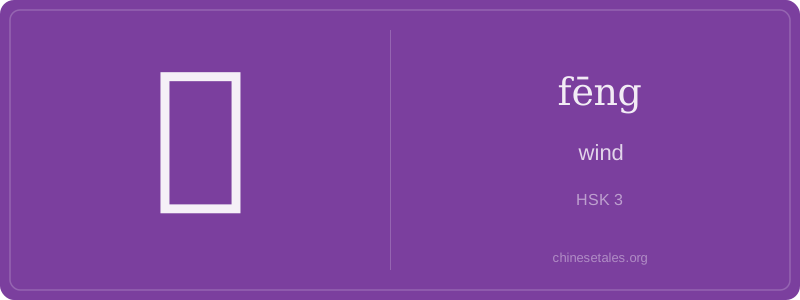
The earliest form of 风 appears in oracle bone inscriptions as a stylized pictograph: a square or circle (representing air or breath) wrapped by curved lines suggesting swirling motion—like wind spiraling around a vortex. By the bronze script era, it evolved into a more abstract shape with a top element (later simplified to 几) and a distinctive ‘insect’-like lower part (虫), which wasn’t literal insects—but a phonetic loan symbol borrowed from the character 虫 (chóng) because ancient pronunciations overlapped. Over centuries, the curves tightened, the ‘insect’ shrank and rotated, and by the Han dynasty clerical script, it had crystallized into today’s four-stroke form: (top left curve), (top right curve), 丿 (descending stroke), and 一 (horizontal base).
This visual journey mirrors its semantic expansion: from tangible, howling wind in the Book of Odes (《诗经》)—‘The wind rises, the grass ripples’—to abstract influence in Daoist texts (e.g., Zhuangzi’s ‘wind of the void’). Even the ‘insect’ component, though phonetic, subtly echoes wind’s invisible yet pervasive nature—like tiny creatures carried unseen on air currents. The character’s simplicity (just four strokes!) belies its philosophical depth: it’s the first radical in the Kangxi Dictionary precisely because wind precedes all movement—it sets things in motion before form takes shape.
At its heart, 风 (fēng) isn’t just ‘wind’—it’s the invisible force that carries scent, sound, and change. In Chinese, it breathes life into metaphors: a person’s ‘style’ is their fēng (风格), gossip is ‘wind news’ (风闻), and sudden fame is ‘riding the wind’ (乘风而起). Unlike English, where ‘wind’ is mostly physical, 风 in Chinese often implies *influence*, *trend*, or *atmosphere*—so you’ll hear about ‘social winds’ (社会风气) or ‘a wind of reform’ (改革之风), not just gusts.
Grammatically, 风 is usually a noun but pairs effortlessly with verbs like 吹 (blow), 刮 (scrape/sweep—used for strong wind), or 带来 (bring). Watch out: learners often misplace it in compound verbs—saying *吹风* (chūi fēng) means ‘to blow wind’ (literally), but in context it can mean ‘to hint’ or ‘to lobby quietly’ (e.g., 他在领导面前吹风). Also, avoid confusing it with weather terms like 气 (qì, ‘air’) or 雨 (yǔ, ‘rain’)—风 never means ‘weather’ alone; it’s always the *moving air* component.
Culturally, 风 anchors classical cosmology: in fēng shuǐ (风水), it’s half the equation—the flow of vital energy across land. And historically, ‘wind’ carried moral weight: Confucius said, ‘The wind blows and the grass bends’ (风行草偃), meaning leaders shape society by example—not decree. A common slip? Writing 风 as if it were 飞 (fēi, ‘to fly’)—but 飞 has no ‘insect’ component and only three strokes. Remember: 风 *is* the radical—it stands alone, proudly unmodified.