饱
Character Story & Explanation
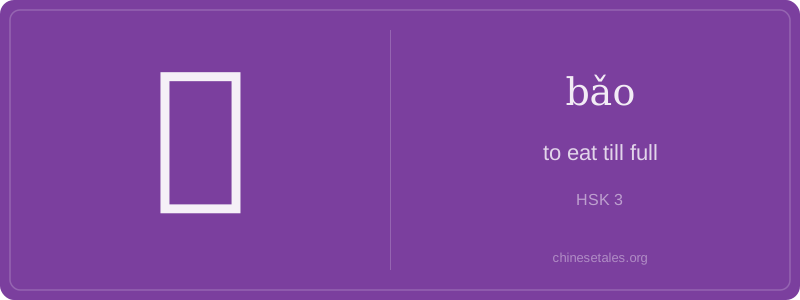
The earliest form of 饱 appears in bronze inscriptions as a combination of 食 (food, later simplified to 饣) and 包 (bāo, ‘to wrap’ or ‘to enclose’). The original pictograph showed a hand placing food into a container — a visual metaphor for containment, completion, and sufficiency. Over centuries, 食 shrank into the left-side radical 饣 (‘food radical’), while 包 evolved: its top became 丿 + 乛, its bottom simplified from 勹+巳 to 丶 + 一 + 丨 — yielding today’s elegant 8-stroke form: 饣 + 保 (though note: it’s not actually 保 — it’s 包’s cursive simplification, misread by many learners as 保).
This character first appeared in the Warring States period texts as a descriptor of bodily satiety, but quickly gained philosophical heft. Mencius wrote, ‘有恒产者有恒心,苟无恒产,因无恒心。’ — implying that only those who are consistently 饱 can sustain moral resolve. By the Tang dynasty, poets used 饱 to evoke sensory richness: Du Fu described ‘饱看秋山’ (bǎo kàn qiū shān) — ‘feasting one’s eyes on autumn mountains’ — extending the verb-complement logic beyond eating into aesthetic fulfillment, a usage still alive today.
At its heart, 饱 isn’t just ‘full’ — it’s the warm, satisfied weight of a belly after a proper meal, the quiet pride in having eaten well. In Chinese, it carries emotional resonance: being 饱 signals safety, care, and even moral grounding (Confucius said ‘a full stomach is the foundation of virtue’). It’s an adjective that behaves like a verb in sentences — you don’t say ‘I am full’ with 是; you say 我吃饱了 (wǒ chī bǎo le), where 饱 is the result complement of 吃, marking completion and physical fulfillment.
Grammatically, 饱 almost never stands alone. It clings to verbs — especially 吃 — as a resultative complement (e.g., 吃饱, 喝饱, 看饱), or appears in fixed phrases like 饱满 (bǎo mǎn, ‘plump/full/robust’) or 饱和 (bǎo hé, ‘saturated’). Learners often wrongly use it like English ‘full’ — saying *我很饱 to mean ‘I’m full’ — but that’s unnatural unless contextually emphatic (e.g., refusing seconds). Native speakers prefer 我吃饱了 or simply 我吃好了 for everyday use.
Culturally, 饱 is deeply tied to scarcity memory: China’s long history of famine makes ‘eating till full’ not just physiological, but profoundly social and even political. A child who eats until 饱 is thriving; a nation that ensures its people are 饱 is just. Don’t confuse it with 胖 (pàng, ‘fat’) — 饱 is temporary, joyful, and earned; 胖 is physical, neutral or sometimes negative. Also, avoid overusing 饱 in abstract contexts — it resists metaphorical stretching (no ‘饱 knowledge’ — use 丰富 instead).