香
Character Story & Explanation
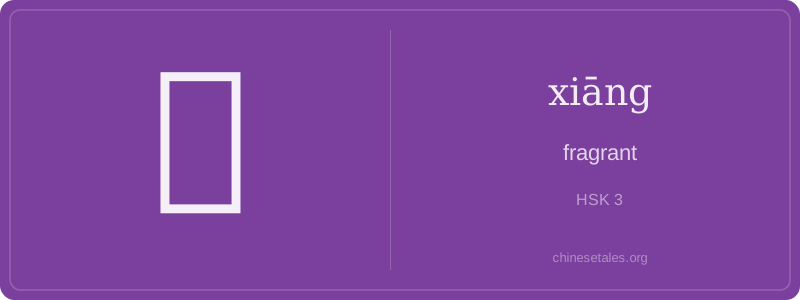
The earliest form of 香 appears on Shang dynasty oracle bones as a stylized pictograph: a grain vessel (represented by 米 at the bottom) topped with a simplified representation of rising smoke or steam (the top part, later evolving into 禾 + 日/甘). It wasn’t about flowers or perfume — it was rice steaming in a pot, releasing aromatic vapors during ancestral offerings. Over centuries, the upper part standardized into 禾 (grain stalk) above 甘 (sweet/tasty), reinforcing the idea that true fragrance arises from nourishment, purity, and delight — not just olfaction.
This origin explains why 香 appears in classical texts like the *Book of Rites* (《礼记》), where ‘fragrance’ symbolizes moral integrity: ‘君子之德,香远益清’ (‘A noble person’s virtue spreads fragrance far and grows ever purer’). The visual logic holds — the ‘grain’ (禾) suggests sustenance and earthiness; the ‘sweet’ (甘) implies harmony and goodness. So 香 isn’t just sensory — it’s ethical, cultural, and deeply agricultural at its roots.
At its heart, 香 isn’t just 'fragrant' — it’s the sensory signature of warmth, care, and sacred presence in Chinese life. Think of incense curling in a temple, freshly steamed baozi at dawn, or your grandmother’s jasmine-scented hair oil: 香 carries emotional weight, evoking comfort, reverence, and authenticity. Unlike English ‘fragrant’ (which can sound formal or even clinical), 香 is deeply embodied — you *feel* it in your chest, not just smell it.
Grammatically, 香 is most often an adjective (e.g., 这花很香), but it also appears in verb-like constructions like 香得流口水 (‘so fragrant it makes you drool’) — a vivid resultative pattern learners often miss. Crucially, it’s rarely used alone as a noun; you don’t say *‘I like 香’ — you say 我喜欢香味 (‘the scent’) or 香气 (‘aroma’). Forgetting this leads to unnatural phrasing.
Culturally, 香 bridges the earthly and spiritual: burning incense (烧香) is both ritual and social glue — a way to honor ancestors, ask for blessings, or simply pause in stillness. Western learners sometimes over-translate it as ‘smell’ (闻), but 香 is exclusively *pleasant*, never neutral or bad (that’s 臭). Also, beware: 香 is a standalone radical — meaning no other character shares this as a semantic component — making it visually unique but easy to miswrite if strokes are rushed.