马
Character Story & Explanation
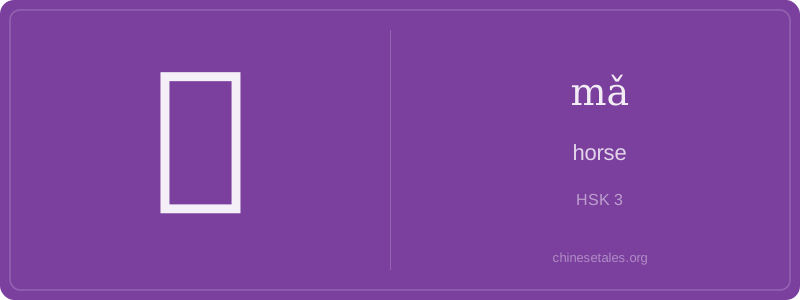
The earliest form of 马, carved on oracle bones over 3,000 years ago, was a vivid side-view sketch: head with flowing mane, upright ears, arched neck, sturdy body, and two bold legs — sometimes even with a tail! Over centuries, the pictograph simplified: the head became the top dot and short stroke, the body and legs fused into the sweeping vertical hook (the third stroke), and the tail vanished entirely. By the small seal script era, it had already settled into a compact, balanced shape — three strokes capturing essence over anatomy, much like a master ink painter’s single brushstroke suggesting galloping motion.
This visual distillation mirrors its semantic evolution: from concrete livestock in Shang dynasty rituals (horses were buried with nobles as status symbols), to a metaphor for speed and readiness in Warring States texts, and finally to idioms like 马到成功 (mǎ dào chéng gōng — ‘victory upon arrival’, evoking cavalry charge). Even today, the character’s open, forward-leaning posture — that decisive hook — echoes its ancient role: not a passive beast, but an engine of movement, will, and momentum.
At its heart, 马 (mǎ) isn’t just ‘horse’ — it’s energy, speed, and restless spirit. Unlike English where ‘horse’ is neutral, in Chinese, 马 often carries connotations of vigor, ambition, or even impatience (think 马上 — ‘immediately,’ literally ‘on horseback’). It’s one of the few characters that doubles as both a noun and a radical — meaning when you see 马 on the left or top of other characters (like 骑 qí ‘to ride’ or 驾 jià ‘to drive’), you know horses are involved, literally or metaphorically.
Grammatically, 马 appears in many fixed expressions: 马上 (mǎ shàng) for urgency, 马虎 (mǎ hu) for carelessness (originally ‘horse + tiger’ — a careless mix!), and as a classifier in rare contexts (e.g., 一马当先 yī mǎ dāng xiān — ‘take the lead like the first horse’). Learners often mispronounce it as ‘ma’ without the falling tone — but mǎ isn’t ‘ma’ like ‘mom’; it’s sharp and decisive, like snapping reins.
Culturally, horses symbolize loyalty and endurance in classical poetry (Li Bai wrote of galloping across mountains), yet modern usage leans idiomatic: calling someone a ‘workhorse’ is 老黄牛 (lǎo huáng niú), not 马 — revealing how 马 has shifted from literal animal to abstract force. A common mistake? Using 马 alone as a verb (‘to horse around’) — nope! That’s 胡闹 (hú nào). Stick to nouns, adverbs, or compound words — and remember: this three-stroke character packs millennia of motion into a single glance.