部
Character Story & Explanation
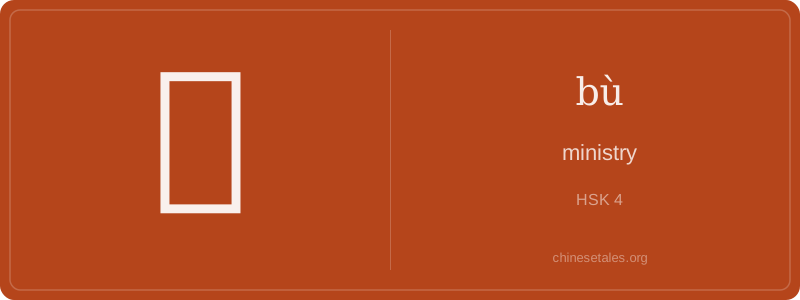
The earliest form of 部 appears in seal script as a combination of 阜 (fù, ‘mound’ or ‘hill’, later simplified to the left-side 阝 radical) and 否 (fǒu, meaning ‘no’ or ‘to obstruct’). But here’s the twist: in ancient bronze inscriptions, the right side wasn’t 否 — it was a stylized depiction of *two hands holding a banner*, symbolizing command and division of troops. Over centuries, the banner morphed into 否 through phonetic borrowing, while the left-side 阝 (originally 阜, meaning ‘mound’ or ‘elevated place’) hinted at a raised platform where officials gathered — literally, a seat of administration.
By the Han dynasty, 部 had solidified as a term for ‘administrative division’ — notably in the Records of the Grand Historian, where Sima Qian describes tribal groups being ‘divided into departments’ (分部) under imperial oversight. Its visual duality — mound + command — perfectly mirrors its semantic duality: both a physical unit (a section of land or text) and an abstract unit of governance. Even today, when you see 部 in 教育部, you’re seeing 2,000 years of bureaucratic lineage in ten clean strokes.
Think of 部 (bù) as China’s ‘department store’ — not for shopping, but for organizing power. Unlike English ‘ministry’, which evokes solemn cabinet meetings, 部 carries a quietly bureaucratic energy: it’s the label on office doors, the suffix that turns a job title into an institution (like 教育部 — 'Education Department'), and even the humble word for 'a part' or 'section' of a book or film. It feels institutional but approachable — like the difference between 'The Department of Transportation' and 'the transportation desk'.
Grammatically, 部 is never used alone in speech; it always appears in compounds or after a modifier. You’ll never say *‘bù’* by itself to mean ‘ministry’ — it’s always 教育部, 文化部, or 军事部. Interestingly, it also doubles as a measure word for books, movies, and TV series (e.g., 一部电影), much like English uses ‘a volume’ or ‘a series’. Learners often mistakenly treat it as a standalone noun or misplace it in compound order — remember: the modifier *always* comes first, and 部 is the anchor at the end.
Culturally, 部 reflects China’s deep-rooted administrative tradition — the character has denoted governmental divisions since the Han dynasty, and today it subtly reinforces how authority is both segmented and systematized. A common mistake? Confusing it with 布 (bù, ‘cloth’) — same sound, totally different world. Also, don’t assume all government agencies use 部: some (like 公安局) use 局 instead, signaling different jurisdictional weight.