使
Character Story & Explanation
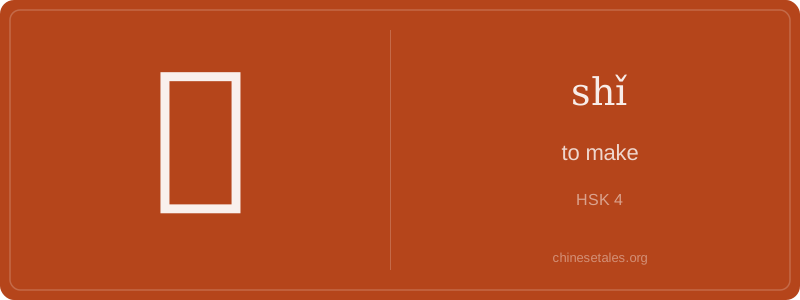
The earliest form of 使 appears on late Shang oracle bones as a compound: a walking person (辵 or 彳, later simplified to 亻) paired with a hand holding a staff or whip (吏-like element). By Zhou bronze inscriptions, it had crystallized into 亻+吏 — the ‘person’ radical anchoring agency, and 吏 (a scribe or official) representing authority and delegated power. The modern 8-stroke version dropped the full 吏 and streamlined it to 使: 亻 (2 strokes) + the top of 吏 (6 strokes: 一丨丶), preserving the sense of a person acting *with official capacity*.
This visual logic shaped its meaning: from ‘to dispatch an official envoy’ in early texts like the *Zuo Zhuan*, 使 expanded to mean ‘to cause’ or ‘to make happen’ — always implying purposeful, often hierarchical, influence. Confucius used it in Analects 12.19: ‘jūn zǐ chéng rén zhī měi, bù chéng rén zhī è. xiǎo rén fǎn shì.’ (‘The gentleman helps others achieve goodness; he does not help them achieve evil’) — where ‘chéng’ (to complete) echoes 使’s causative nuance. Even today, the stroke order (starting with the human radical) reminds us: 使 is about *people initiating change*, not abstract forces.
Imagine you’re watching a skilled puppeteer in a Beijing opera house: with a subtle flick of the wrist, she makes a wooden figure bow, leap, or weep — not because it wants to, but because she causes it to. That’s the essence of 使 (shǐ): it’s not just ‘to make’ like forcing someone to clean their room; it’s about *causing a change in state or behavior*, often with intention, authority, or indirect influence. It’s the verb that turns ‘he is tired’ into ‘the long speech made him tired’ — always followed by a result or effect (e.g., 使…疲惫, 使…明白).
Grammatically, 使 is a causative verb — and here’s where learners stumble: it *must* be followed by a verb or adjective describing the resulting state (never a noun alone), and it never takes ‘le’ or ‘guo’. You’ll hear it constantly in formal writing, news reports, and academic speech — but rarely in casual chat (where ‘ràng’ or ‘jiào’ are more common). Saying ‘tā shǐ wǒ kāixīn’ (he makes me happy) is perfectly correct, but saying ‘wǒ shǐ tā’ (I make him) without specifying *what* he became or did is incomplete — like handing someone a remote control but forgetting to press play.
Culturally, 使 carries quiet weight: it appears in diplomatic titles (shǐzhě — envoy), historical texts (‘shǐ qín wáng sè biàn’ — ‘causing the King of Qin’s face to change color’ in *Strategies of the Warring States*), and even in modern tech jargon (shǐyòng — ‘to use’, literally ‘cause-to-use’). A classic mistake? Using 使 when you mean ‘to use’ as a simple action — that’s shǐyòng, not *shǐ* alone. Remember: 使 doesn’t *do* — it *triggers*.