性
Character Story & Explanation
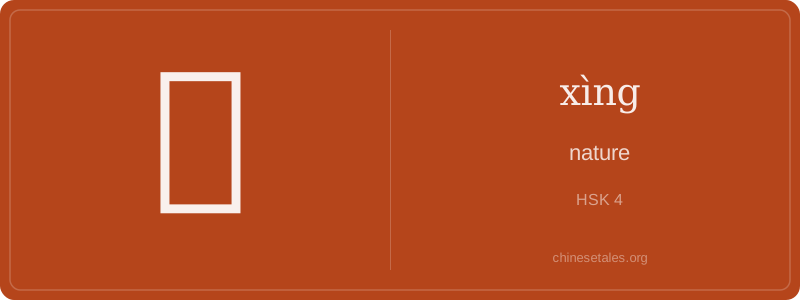
Carved on Shang dynasty oracle bones, the earliest form of 性 looked nothing like today’s character — it combined 生 (shēng, 'to be born') with 心 (xīn, 'heart/mind') or sometimes 氏 (shì, an ancient clan marker), suggesting 'inborn disposition rooted in the heart.' Over centuries, the left side simplified into 忄 (the 'heart-mind' radical), while the right evolved from 生 into a stylized form retaining its core strokes: the horizontal line, vertical stroke, and curved 'life' hook. By the Han dynasty clerical script, it had settled into the 8-stroke structure we know — a visual promise: what lives in the heart is what *is*.
This character was central to classical debates: Mencius declared 'Human nature is good' (性善 *xìng shàn*), while Xunzi countered 'Human nature is evil' (性恶 *xìng è*). Crucially, 性 never meant 'sex' in pre-modern texts — that sense emerged only in the 20th century, influenced by Western psychology and translation needs. The visual continuity — heart + life — quietly holds both meanings: the deepest truth of who we are, and the most fundamental biological fact of being alive.
Imagine you’re at a tea ceremony in Suzhou, watching a master pour water over aged pu’er. She says, 'This tea’s *xìng* is warm — it nourishes the spleen.' Not 'temperature' or 'flavor,' but its deep, intrinsic quality: its *nature*. That’s 性 — not just 'nature' as in 'human nature,' but the essential, unchangeable quality that defines what something *is*, whether it’s tea, a person’s temperament, or a chemical compound.
Grammatically, 性 is almost always a noun suffix, like English '-ness' or '-ity.' You rarely use it alone; instead, it attaches to adjectives (e.g., 安全 *ānquán* → 安全性 *ānquánxìng*, 'safety' as a property). It also appears in fixed compounds like 性格 (xìnggé, 'personality') and 性别 (xìngbié, 'gender'). A classic learner trap? Using 性 where you need 的 — saying *tā de xìng* ('his nature') when you mean *tā de xìnggé* ('his personality'). 性 doesn’t take possessive 的 unless part of a longer phrase like 他的性格.
Culturally, 性 carries quiet philosophical weight. In Confucian thought, 性 (xìng) refers to innate human goodness — Mencius argued humans are born with moral *xìng*, like sprouts waiting for cultivation. But modern usage has broadened: 性 can mean 'sex' (as in 性生活 *xìng shēnghuó*, 'sex life'), a shift that surprises learners. This dual meaning isn’t random — both senses stem from the idea of 'essential, defining quality': one metaphysical, one biological. Handle with semantic care!