合
Character Story & Explanation
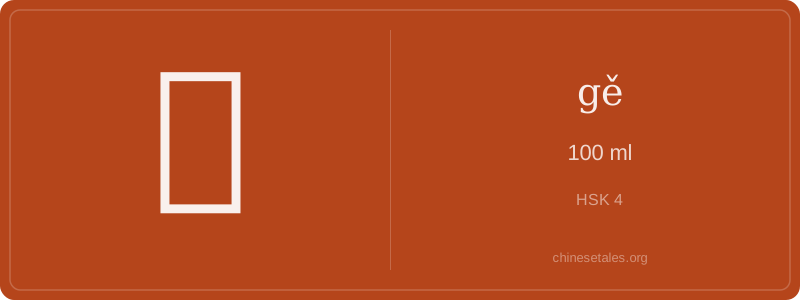
The earliest form of 合 appears in bronze inscriptions as a pictograph showing a lid (亼, later simplified to 人 atop 口) fitting snugly over a mouth-shaped vessel (口). Think of a covered rice bowl: the top part — originally resembling a roof or lid — pressing down onto the open mouth below. Over time, the lid evolved into the top strokes (人 + 一), while the vessel remained 口 — giving us today’s clean, balanced six-stroke structure: 亼 + 口. Every stroke reinforces containment and closure.
This visual logic shaped its semantic journey: from ‘lid fitting vessel’ → ‘to close/cover’ → ‘to join perfectly’ → ‘to agree’ (as minds align) → ‘to be suitable’ (as parts match). In the Shuōwén Jiězì (100 CE), Xu Shen defined it as ‘mouth closed by a lid — symbolizing agreement and unity’. Confucius praised ‘君子和而不同,小人同而不和’ (gentlemen harmonize without conforming), using 和 (hé) — but 合 underlies that harmony: true ‘harmony’ begins with things that genuinely *fit*.
Let’s cut through the confusion first: 合 (gě) as a unit of volume — 100 ml — is a rare, almost nostalgic usage today. You’ll mostly encounter it on old-style soy sauce bottles, traditional medicine prescriptions, or in regional dialect contexts (like Shanghainese markets). Its core meaning is ‘to join’, ‘to fit together’, or ‘to be in harmony’ — and that idea of ‘two things coming together to make a whole’ is key: one 合 equals exactly the amount that fits neatly into a standard small ceramic cup — a perfect union of container and content.
Grammatically, 合 (gě) functions only as a measure word for liquids (never solids), always placed directly after a number: 一合 (yī gě), 三合 (sān gě). It’s never used with classifiers like ‘个’ or ‘瓶’. Crucially, it’s *not* interchangeable with 升 (shēng) or 毫升 (háoshēng): 1 合 = 0.1 liter, not 1 liter — a classic learner trap! Saying ‘两合水’ (liǎng gě shuǐ) means ‘200 ml water’, not ‘2 liters’.
Culturally, this usage feels like holding a Ming-dynasty teacup — elegant, precise, and quietly disappearing. Younger urban Chinese rarely use it; they say ‘100毫升’. But encountering 合 in a herbalist’s shop or an antique cookbook signals authenticity and historical texture. The biggest mistake? Pronouncing it as ‘hé’ here — that instantly shifts meaning to ‘unite’ or ‘agree’, turning your order for soy sauce into a philosophical declaration!