由
Character Story & Explanation
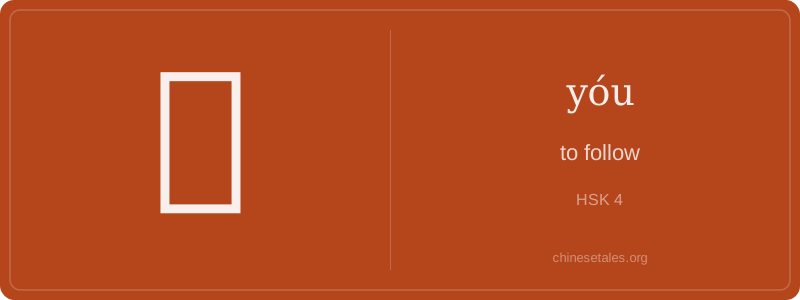
The earliest form of 由, found on Shang dynasty oracle bones, looked like a stylized ‘well-field’ — a square with a central cross, representing the ancient Chinese agricultural layout where land was divided into nine equal plots (like a # symbol inside a box). That original pictograph wasn’t about wells or fields per se, but about *bounded space*, *defined origin*, and *central control*. Over centuries, the outer square simplified into the 田 radical (‘field’), while the inner cross became the vertical stroke piercing through — evolving into today’s clean, minimalist five-stroke form: 丨 (vertical line) cutting cleanly through 田.
This visual journey from ‘regulated field system’ to abstract ‘origin’ is profound: the well-field was the foundational unit of Zhou dynasty governance — land, duty, and social order all flowed *from* that structure. So 由 carried connotations of legitimacy, source, and rightful derivation. Confucius himself used it in the Analects (12.11) when stressing moral authority: ‘名不正,则言不顺;言不顺,则事不成…事不成,则礼乐不兴;礼乐不兴,则刑罚不中…’ — though 由 doesn’t appear there directly, its conceptual sibling (origin of names, of rites) underpins the entire argument. The character’s stillness — a single line grounding the field — mirrors how Chinese thought treats origins: quiet, non-negotiable, and structurally essential.
At its heart, 由 isn’t just ‘to follow’ — it’s about *origin*, *cause*, and *agency*: the invisible thread that connects a starting point to an outcome. Think of it as Chinese philosophy’s quiet nod to causality: ‘This happened *by* that,’ ‘It arose *from* this,’ ‘She acted *under* those conditions.’ It feels less like passive obedience and more like tracing roots — deeply resonant in a culture that values lineage, context, and respectful acknowledgment of sources (a teacher’s influence, a policy’s intent, history’s weight).
Grammatically, 由 is a preposition — but not like English ‘by’ or ‘from.’ It introduces the *source*, *agent*, or *basis* in formal or written contexts, especially in passive constructions (e.g., 这个决定是由校长做出的 — ‘This decision was made *by* the principal’). Learners often mistakenly use it where English uses ‘because of’ (that’s 因为); 由 never expresses reason — only origin or agency. Also, it rarely appears in casual speech; you’ll hear it in news reports, official notices, or academic writing — a subtle signal of register.
Culturally, 由 reflects a worldview where nothing exists in isolation: every action, idea, or status has a traceable source. Misusing it (e.g., saying ‘由天气不好,我们没去’ instead of ‘因为天气不好’) sounds jarringly bureaucratic — like quoting a municipal ordinance at a picnic. And watch the tone: yóu (second tone) is easily confused with yǒu (third tone, ‘to have’) — a slip that turns ‘originated by’ into ‘has,’ derailing logic entirely.