将
Character Story & Explanation
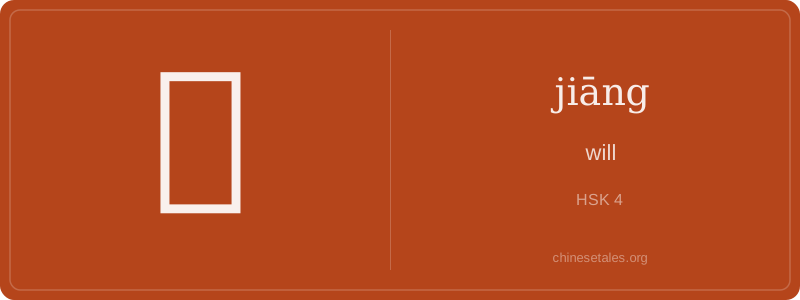
The earliest form of 将 appears in bronze inscriptions (c. 1000 BCE) as a compound pictograph: a hand (又) holding a sacrificial vessel (冓-like element, later stylized into the top part) — symbolizing ritual offering or presentation. Over centuries, the vessel simplified into the upper component (丬 + 丨 + 一), while the hand evolved into the lower 口 + 寸. By the seal script era, the shape had crystallized into the modern 9-stroke form: radical 丬 (a variant of 床, ‘bed’ — here repurposed as a phonetic/semantic hint related to ‘supporting’ or ‘presenting’), plus the phonetic component 寸 (cùn, ‘inch’, indicating pronunciation and implying measured, deliberate action).
This visual logic mirrors its semantic journey: from ‘to present an offering’ in Shang dynasty rituals → ‘to bring forth’ (in classical texts like the *Zuo Zhuan*) → ‘to lead troops’ (hence jiàng, ‘general’) → and finally, by Tang-Song dynasties, the grammaticalized future marker ‘will’, reflecting the idea of *bringing the action into being*. The character’s very structure — a supporting frame (丬) anchoring precise, intentional action (寸) — embodies its core sense: not passive prediction, but active, controlled initiation of what’s next.
Imagine you’re texting a friend in Beijing: 'I’ll call you tomorrow.' In Chinese, you wouldn’t say *wǒ huì gěi nǐ dǎ diànhuà* (using 会) — you’d say *wǒ jiāng gěi nǐ dǎ diànhuà*. Why? Because 将 isn’t just ‘will’ — it’s the quiet, confident, slightly formal promise of something *about to happen*, like a general raising a banner before battle. It carries weight, intention, and inevitability — not mere possibility (like 会) or habitual action (like 要). It’s the ‘will’ of written notices, news headlines, and polite plans: *Míngtiān tā jiāng fābù yīgè zhòngyào shēngmíng.*
Grammatically, 将 is a pre-verbal auxiliary — it always comes right before the verb, never at the sentence end. It *cannot* stand alone as a main verb (unlike 将 as jiàng, meaning ‘to command’), and it *never* takes aspect particles like 了 or 过. Learners often mistakenly insert 了 after 将 (*wǒ jiāng chī le* ❌) — but that’s ungrammatical; the time marker belongs *before* 将 (*Míngtiān wǒ jiāng chī* ✅). Also, 将 feels more literary or formal than 要 — using it in casual chat with friends can sound oddly solemn, like addressing a council of elders.
Culturally, 将 reflects Chinese linguistic elegance: preferring compact, context-rich markers over auxiliary verbs. Its usage peaks in official announcements, legal texts, and classical-style writing — think government press releases or historical dramas. A common trap? Overusing it trying to sound ‘more Chinese.’ Remember: if you’d say ‘gonna’ in English, skip 将 and use 要 or even just context. Reserve 将 for moments when the future feels like a decree — not a guess.