丢
Character Story & Explanation
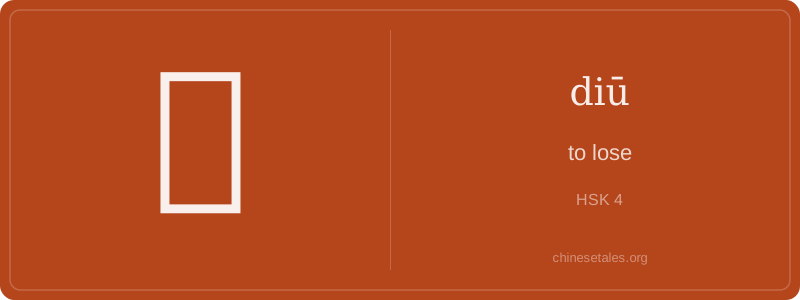
The earliest form of 丢 is shockingly literal: a Shuōwén Jiězì (c. 100 CE) seal script variant shows a hand (扌 radical, later simplified) gripping what looks like a bundle or cloth — and letting it *fall* downward. By Song dynasty, the hand morphed into the top-left 丿 (piě) stroke, the falling object condensed into the central 云-like shape (a stylized ‘bundle’), and the bottom horizontal 一 (yī) emerged as the ground — or perhaps the floor where the thing landed with a soft thud. Six strokes total: 丿 (falling hand), 丨 (vertical support), 一 (ground), then the three short strokes forming the ‘cloud’-shaped core — not clouds at all, but a tumbling package.
This visual logic stuck: 丢 has always meant ‘to drop, let fall, thereby lose’. It first appeared in Ming-Qing vernacular novels like *Jin Ping Mei*, where servants ‘lost’ (丢) silver ingots through sloppiness — reinforcing its connotation of avoidable failure. The radical 一 (yī) isn’t decorative; it’s the floor, the baseline of consequence. No wonder it’s never used for noble losses — you wouldn’t 丢 your honor (that’s 失), only your umbrella, your temper (in slang: 丢脾气), or your dignity in public (丢脸).
At its core, 丢 (diū) isn’t just ‘to lose’ in the neutral sense — it carries a subtle sting of carelessness, embarrassment, or even moral failure. Think of dropping your phone down a subway grate, forgetting your keys *again*, or misplacing an important document: 丢 implies you *let it happen*. That’s why it’s often used reflexively (丢了) — the loss feels personal, almost accusatory. Unlike English ‘lose’, which can be passive ('I lost my way'), 丢 usually suggests human agency gone awry.
Grammatically, it’s wonderfully flexible: it can take objects directly (丢钱包), appear in resultative complements (找不丢 — 'can’t find it back', though rare), and shine in idioms like 丢人 (diūrén, 'to lose face'). A classic learner trap? Using 丢 for abstract losses like 'lose patience' — no! That’s 失去 (shīqù). Also, never say *wǒ diū le tā* to mean 'I lost him' (as in a person); that sounds like you accidentally abandoned someone — use 迷路 (mílù) or 走散 (zǒusàn) instead.
Culturally, 丢 reflects a deep-rooted Chinese sensitivity to social accountability: losing something isn’t just inconvenient — it hints at negligence, lack of diligence (勤), or even a breach of trust. In classical texts, 丢 rarely appears (it’s late, colloquial), but its modern dominance in speech — especially in phrases like 丢脸 (diūliǎn, 'lose face') — reveals how much weight Chinese places on visible, socially witnessed competence.