仍
Character Story & Explanation
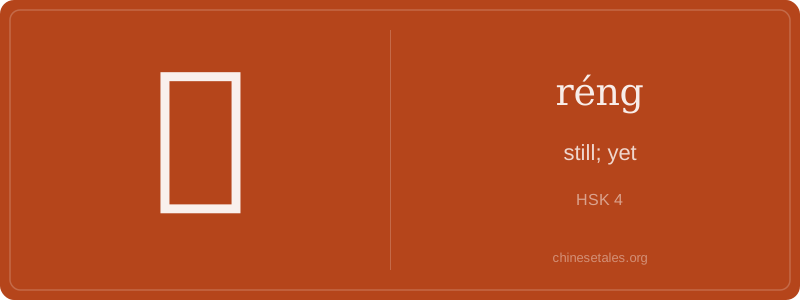
Originally carved on oracle bones over 3,000 years ago, 仍 began as a pictograph combining 人 (rén, ‘person’) and 乃 (nǎi, an ancient variant of ‘to hold’ or ‘to follow’ — later stylized into the lower part). In bronze inscriptions, it appeared as a standing figure with a curved line descending from the shoulder — visualizing someone *continuing to hold position*, not stepping away. Over centuries, the upper ‘person’ radical 亻 solidified, while the lower component simplified from a complex curve into the clean, flowing 乃 shape we write today — four swift strokes:撇 (piě), 竖 (shù), 横折折折钩 (héng zhé zhé zhé gōu), and 撇 (piě).
This visual origin directly shaped its meaning: not mere ‘stillness’, but *active, embodied continuation*. By the Warring States period, texts like the *Zuo Zhuan* used 仍 to describe ministers who ‘still served’ their lords amid political upheaval — loyalty persisting *through* chaos. Its form — a person anchored by the curving 乃 — became a metaphor for resilience: the human spirit bending but not breaking. Even today, when you write those four strokes, you’re tracing an ancient gesture of steadfast presence.
At its heart, 仍 (réng) isn’t just a dry ‘still’ — it’s the quiet insistence of continuity in the face of change. Think of rain still falling after the storm has 'passed', or a student still studying at midnight despite exhaustion: it conveys persistence without drama, endurance without fanfare. This reflects a deeply Chinese sensibility — valuing steady effort (恒心, héngxīn) over sudden triumph, and recognizing that real progress often looks like quiet repetition, not flashy breakthroughs.
Grammatically, 仍 is an adverb placed *before* the verb or adjective, almost always in formal or written contexts (you’ll rarely hear it in casual speech — natives say 还 instead). It often appears with contrastive conjunctions like 虽然…仍… ('although…still…') or even standalone in news headlines: ‘经济复苏,失业率仍高’ (Economic recovery underway, yet unemployment remains high). Crucially, it *cannot* modify nouns — you can’t say ‘仍学生’; it modifies the state or action itself.
Learners frequently overuse 仍 in spoken Chinese, sounding stiff or unnatural — imagine saying ‘我仍饿’ instead of ‘我还饿’. Also, confusing it with 仍 vs. 仍 vs. 乃 (nǎi, ‘thus/therefore’) leads to nonsensical logic. And here’s the subtle cultural nuance: 仍 often implies *unexpected* continuity — the fact that something persists *despite* conditions suggesting it shouldn’t. That slight tension — between expectation and reality — is where its quiet power lives.