估
Character Story & Explanation
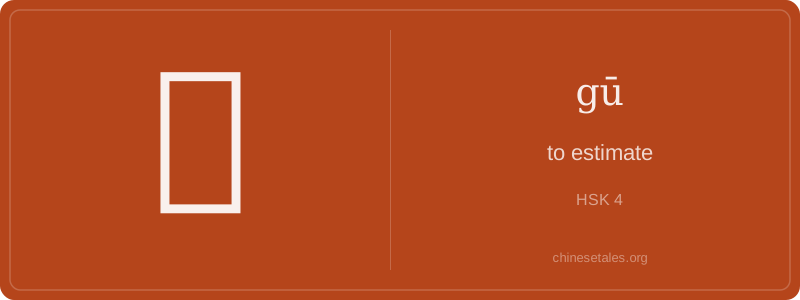
The earliest form of 估 appears in Warring States bamboo slips—not as a pictograph, but as a phonosemantic compound already. Its left side 亻 (rén bàng, 'person radical') signals human agency; its right side 古 (gǔ, 'ancient') originally provided sound, but also carried subtle semantic weight: ancient sages were revered for their measured judgments. Stroke by stroke, it evolved from a more complex seal-script form with a fuller 'ancient' component into today’s clean seven-stroke shape: two strokes for the person radical (撇 + 竖), then five for 古 (横 + 竖 + 竖 + 横折 + 横)—a structure so balanced it looks like someone standing calmly while holding up a mental measuring stick.
By the Han dynasty, 估 appears in texts like the Shuōwén Jiězì, defined as 'to weigh value with the mind'—not physical weighing, but cognitive appraisal. In Tang poetry, it surfaces in economic contexts: merchants 估货 (gū huò, estimating goods’ worth before trade). Over centuries, 古’s 'ancient' meaning receded, but its resonance remained: estimation isn’t random—it’s grounded in tradition, precedent, and collective experience. Even today, when a project manager says 我们得先估一下工期 (We need to estimate the timeline first), they’re echoing millennia of pragmatic reckoning.
Think of 估 (gū) as Chinese’s version of a weather forecaster squinting at cloud patterns—not with instruments, but with intuition and experience. It’s not about precise calculation (that’s 算 suàn), nor about guessing blindly (that’s 猜 cuāi); it’s the thoughtful, context-aware estimation you make when you glance at a pile of books and say, 'That’s probably 30 kilos'—a blend of observation, past knowledge, and reasonable judgment. In speech, 估 is almost always transitive and requires an object: you 估价格 (gū jiàgé, estimate the price), 估时间 (gū shíjiān, estimate the time), or 估风险 (gū fēngxiǎn, estimate the risk).
Grammatically, it rarely stands alone—it’s the engine inside compound verbs like 估计 (gūjì) or 低估 (dīgū). Learners often mistakenly use it like English ‘guess’ and slap it at the end of a sentence ('I guess...'), but in Chinese, that role belongs to 我想 (wǒ xiǎng) or 可能 (kěnéng). Also, 估 never takes aspect particles like 了 or 过 directly—it’s the verb inside a phrase: 我估计他已经到了 (Wǒ gūjì tā yǐjīng dào le).
Culturally, 估 reflects a deeply pragmatic Confucian value: wisdom lies not in absolute certainty, but in calibrated judgment amid uncertainty. That’s why you’ll hear 估 in business negotiations, engineering bids, and even casual chats ('你估他多大?'—'How old do you reckon he is?'). A common error? Using 估 where 以为 (yǐwéi, 'to think/believe') fits better—e.g., saying *我估他是老师 instead of 我以为他是老师 ('I thought he was a teacher'). The former implies you’re estimating his profession like a demographic survey!