低
Character Story & Explanation
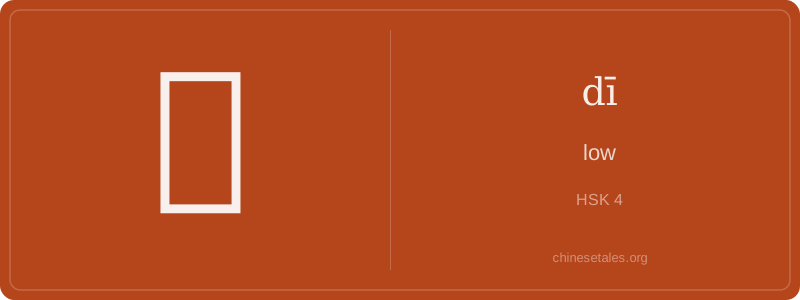
The earliest form of 低 appears in seal script, evolving from a combination of 人 (rén, 'person') on the left and 底 (dǐ, 'base' or 'bottom') on the right — though 底 itself originally depicted 'a vessel resting firmly on the ground'. In the modern 低, the left side is the 亻 (rén bàng, 'person radical'), subtly reminding us that 'lowness' was historically understood through human posture: bowing, crouching, or yielding. The right side, 抵 (dǐ), originally meant 'to press against' or 'to resist', but here it phonetically anchors the sound dī while visually suggesting downward pressure — like a hand gently pressing a person’s head down.
This visual logic deepened over time: in classical texts like the Book of Rites, 低 described ritual postures — lowering one’s gaze or voice to show respect. By the Tang dynasty, poets used 低 to evoke quiet intimacy (e.g., 'lowering one’s voice to whisper to a lover') or melancholy ('a low cloud hovering over the river'). Its shape — compact, grounded, with the person radical literally 'leaning into' the bottom — makes it one of Chinese writing’s most elegantly embodied concepts: lowness as both physical action and social gesture.
At its core, 低 (dī) isn’t just a neutral descriptor like English 'low' — it carries subtle emotional gravity in Chinese. It often implies *undesirable* lowness: low volume, low morale, low status, or low quality. That’s why you’ll rarely hear someone proudly say 我的工资很低 (wǒ de gōngzī hěn dī) — it sounds resigned or even shameful, not factual. Contrast that with English, where 'low salary' can be stated neutrally. This reflects a cultural sensitivity to hierarchy and face: stating something is 'low' can unintentionally highlight deficiency or imbalance.
Grammatically, 低 is mostly an adjective (e.g., 声音很低 shēngyīn hěn dī — 'the voice is very low'), but it also functions as a verb meaning 'to lower' — especially in formal or compound contexts: 低头 (dī tóu, 'to bow one’s head'), 低估 (dī gū, 'to underestimate'). Note: unlike English, you *cannot* use 低 predicatively without a degree word like 很 or 太 — saying *声音低 is incomplete; you need 声音很低. Learners often omit this, creating unnatural speech.
Culturally, 低 appears in powerful idioms like 低声下气 (dī shēng xià qì — 'speak softly and act submissively'), revealing how physical posture (lowered voice, lowered stance) maps directly onto social deference. A common mistake? Confusing 低 with 滴 (dī, 'drop') or 底 (dǐ, 'bottom') — homophones that derail meaning completely. Remember: 低 is about *relative position or degree*, never liquid or literal base.