亮
Character Story & Explanation
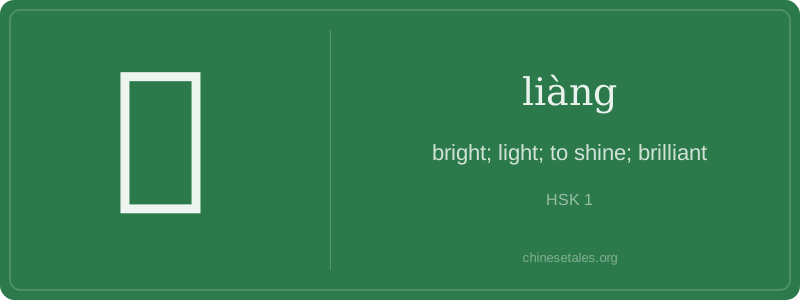
The earliest form of 亮 appears in bronze inscriptions around 1000 BCE as a compound pictograph: the top was 亠 (a roof or canopy), and beneath it was 京 — a tall, multi-story building with windows. Together, they depicted light streaming *through the windows of a high hall*, evoking both illumination and elevated perspective. Over centuries, 京 simplified into 口 (mouth/window) and 几 (a low table/stool-like shape), while the radical 亠 stayed firmly on top — stabilizing the idea of ‘light from above’ or ‘light entering a structure’.
This architectural origin explains why 亮 so naturally extended to metaphorical light: in classical texts like the Zuo Zhuan, ‘bright virtue’ (明德) and ‘bright governance’ (亮政) appear — linking visibility with moral transparency. By the Tang dynasty, poets used 亮 to describe not just dawn (天亮), but also the ‘sudden clarity’ of insight, like a lantern lit in a dark room. Its visual simplicity — just nine strokes, yet layered with structural and ethical meaning — mirrors how Chinese characters encode worldview in form.
At its heart, 亮 isn’t just about physical light — it’s a cultural shorthand for clarity, honesty, and mental acuity. In Chinese, saying someone has ‘a bright mind’ (聪明) is common, but calling them 亮 (e.g., in the slangy phrase 眼睛真亮 — ‘your eyes are really bright!’) implies sharp perception, quick wit, even street-smart awareness. It’s warmth with intelligence — think sunlight cutting through fog, not just a bare bulb.
Grammatically, 亮 is delightfully flexible: it works as an adjective (灯很亮 — ‘the lamp is bright’), a verb meaning ‘to shine’ or ‘to become visible’ (天亮了 — ‘it’s dawned’), and even as a light verb in compounds like 亮相 (to make an appearance). Learners often mistakenly treat it like English ‘shine’ and say *他亮了* to mean ‘he shone’, but without context, that sounds odd — native speakers prefer 他发光了 or use 亮 in set phrases like 天亮了 or 灯亮了.
Culturally, 亮 carries positive moral weight: ‘bright conduct’ (光明正大) means upright, transparent behavior — literally ‘bright light, correct greatness’. And watch out: unlike English ‘bright’, 亮 almost never describes intelligence alone (we say 聪明 or 聪慧); using 亮 for ‘brilliant student’ would confuse listeners. Also, it’s rarely used for artificial brightness (like ‘bright screen’) — 明亮 or 亮堂 are safer choices there.