什
Character Story & Explanation
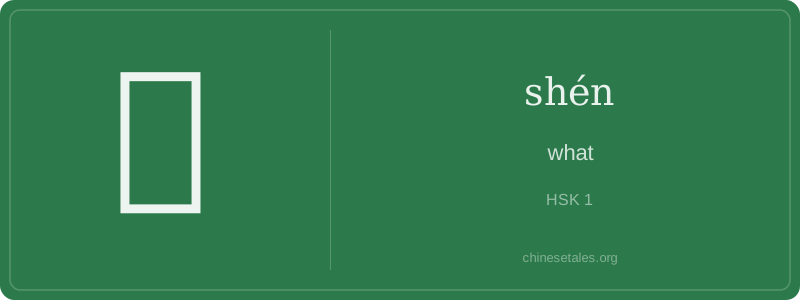
The earliest form of 什 appears in Warring States bamboo slips as a combination of 人 (rén, person) and 十 (shí, ten), written side-by-side. Visually, it wasn’t pictographic like ‘sun’ or ‘tree’ — instead, it was a *phonosemantic compound*: the left side 亻 (a variant of 人) hinted at human-related meaning (e.g., people, things, affairs), while the right side 十 provided the sound clue (shí). Over centuries, the 人 radical simplified into its modern two-stroke 亻 form, and 十 remained nearly unchanged — resulting in today’s clean, balanced four-stroke structure: two strokes for the person radical, two for the ‘ten’ component.
Originally, 什 carried the concrete meaning of ‘ten items’ or ‘a group of ten things’ — think of ancient tax records listing ‘什伍’ (shí wǔ), a military unit of ten households. But by the Han dynasty, its meaning abstracted dramatically: ‘ten things’ became ‘things in general’, then ‘any thing’, and finally — through grammaticalization — the interrogative pronoun ‘what’. This semantic leap mirrors how English ‘thing’ evolved from Old English *þing* (assembly, matter) to a vague placeholder. In the *Analects*, Confucius uses 什 in classical constructions like ‘何什’ (hé shí, ‘what indeed?’), showing its early role in philosophical inquiry — a humble character that quietly became the linguistic hinge of all questioning.
Think of 什 (shén) as Mandarin’s universal question key — like the ‘?‘ button on your smartphone keyboard: it’s small, appears everywhere, and instantly turns any statement into a question about identity or content. Unlike English ‘what’, which can stand alone (*What?*), 什 almost always partners with 吗 (ma) for yes/no questions or with 么 (me) to form the ultra-common 什么 (shén me) — the go-to phrase for ‘what’ in 95% of beginner conversations. It’s never used bare; you’ll never see just ‘什’ floating solo in speech — it’s a team player, not a solo act.
Grammatically, it’s deceptively simple but easy to misplace. Learners often say *Nǐ shén?* (missing ‘me’) — but that’s nonsensical; it must be *Nǐ shén me?* (What are you?) or better yet, *Nǐ shì shén me rén?* (What kind of person are you?). Notice how 什 always kicks off the questioned element — like a spotlight operator who only points at nouns or noun phrases, never verbs or adjectives directly. And crucially: it’s tone 2 (shén), not tone 1 — mispronouncing it as *shī* makes it sound like the number ten (十), causing delightful confusion at the market.
Culturally, 什 carries zero baggage — no formality, no hierarchy, no age sensitivity. It’s the Swiss Army knife of questioning: perfectly neutral whether you’re asking a toddler ‘What’s this?’ or a CEO ‘What’s the strategy?’. A common mistake is over-translating English ‘what’ into 什 when Chinese uses other structures — e.g., ‘What time is it?’ is *Jǐ diǎn le?*, not *Shén me shí jiān?*. That’s because 什 asks for *identity*, not *measurement*. Mastering 什 means mastering curiosity itself — politely, efficiently, and unmistakably.