尽
Character Story & Explanation
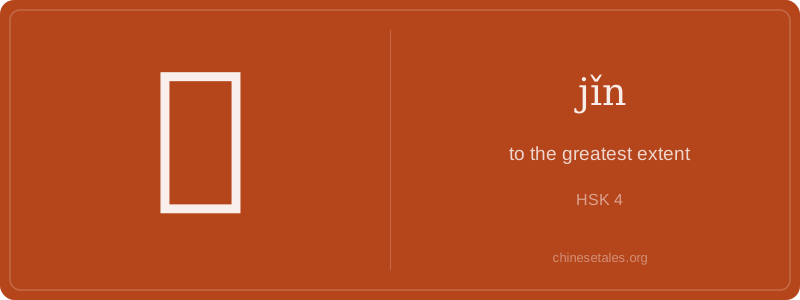
The earliest form of 尽 (found on Warring States bamboo slips) shows a person under a roof (the radical 尸, originally depicting a seated figure or corpse, later stylized as 'roof + person') with a hand (又) reaching downward — not to grab, but to *press down completely*. Over centuries, the 'hand' evolved into the simplified 丷 + 一 + 丶 shape below the 尸, while the lower part condensed into a clean, decisive stroke — six strokes total, symbolizing finality and totality. That original image wasn’t about death, but about exerting force *to the absolute bottom* — like squeezing every last drop from a cloth.
This physical sense of 'pressing to the limit' became philosophical: in the Mencius, 尽心 (jìn xīn) means 'exerting one’s heart-mind to the utmost' — moral effort, not exhaustion. By the Tang dynasty, the pronunciation jǐn emerged for the adverbial use ('as...as possible'), softening the original harshness of jìn ('to exhaust') into something more aspirational and humane. Visually, the 尸 radical isn’t morbid here — it’s the stable foundation from which total effort springs.
Think of 尽 (jǐn) as Chinese’s elegant 'all-the-way' button — it doesn’t mean 'finish' like 完 or 结束, but rather 'as much as possible,' 'to the very limit,' or 'without reservation.' It’s the quiet intensity behind phrases like 尽量 (jǐn liàng, 'as much as possible') or 尽快 (jǐn kuài, 'as soon as possible'). Unlike verbs, 尽 here is an adverbial modifier — always paired with another verb or adjective to crank up its degree. You’ll never say *‘我尽’ alone; it must be ‘我尽量做’ or ‘尽快来.’
Grammatically, jǐn is almost always the first syllable in two-character adverbs ending in -量, -快, -早, -力, -情 — and it *always* carries the third tone. A common mistake? Using it where English says 'very' — nope! 尽 is about effort, scope, or urgency, not mere intensity (that’s 很 or 非常). Also beware tone confusion: jìn (fourth tone) means 'exhaust' or 'use up' (e.g., 用尽), but at HSK 4, you’ll mostly meet jǐn.
Culturally, 尽 reflects a deeply pragmatic Confucian value: doing your utmost within given constraints — not perfection, but full-hearted, context-aware effort. Learners often overuse it trying to sound formal, but native speakers deploy it sparingly and precisely. Notice how it appears in official slogans (尽心尽力, 'wholeheartedly'), yet also in daily requests ('请尽快回复') — a rare character bridging bureaucratic weight and warm urgency.