优
Character Story & Explanation
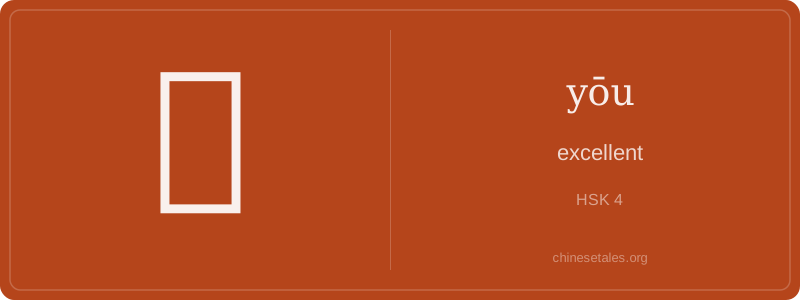
The earliest form of 优 appears in bronze inscriptions as a person (亻) beside a phonetic component 又 (yòu, ‘again’ or ‘hand’), later standardized into the modern six-stroke shape. Originally, it depicted a court entertainer — not just any performer, but one skilled enough to earn royal favor through refined artistry. The left-side 亻 (person) grounds it in humanity, while the right side 尤 evolved from a pictograph of a hand holding a ceremonial object, symbolizing exceptional skill performed before authority.
By the Warring States period, 优 shifted from ‘entertainer’ to ‘excellent’ — a semantic upgrade reflecting how highly valued artistic mastery was in ancient courts. Mencius praised rulers who ‘cherished 优 people’ not for amusement, but for their moral insight and rhetorical brilliance. The character’s visual balance — slender yet stable, simple yet precise — mirrors its meaning: excellence that’s disciplined, not flamboyant. Even today, when Chinese parents write 优 on a child’s test paper, they’re echoing a 2,300-year-old standard of cultivated distinction.
At its heart, 优 isn’t just ‘excellent’ — it’s excellence *with grace*. Think of a dancer who doesn’t just hit every note but makes it look effortless, or a student whose answer is not only correct but insightful and elegantly phrased. In Chinese, 优 carries a quiet dignity: it implies superiority that’s earned, refined, and socially harmonious — never brash or boastful. You’ll see it in school report cards (成绩优秀), job evaluations (表现优异), and even classical praise for virtuous rulers.
Grammatically, 优 rarely stands alone as a verb — unlike English ‘to excel’, you wouldn’t say *‘I 优’*. Instead, it’s almost always an adjective (often paired with 秀, 异, or 良) or part of set phrases like 优势 (advantage) or 优惠 (discount — literally ‘excellent favor’). A classic learner trap? Using 优 where you need 好 (hǎo) — saying *‘这个菜很优’* sounds bizarre; native speakers say *‘很好’* or *‘非常棒’*. 优 belongs to formal, measured praise — not casual compliments.
Culturally, 优 reflects the Confucian ideal of excellence as cultivated virtue: not raw talent, but polished ability aligned with propriety and humility. That’s why 优 often appears alongside characters like 雅 (elegant) or 秀 (outstanding) — it’s excellence *in harmony*. Learners also mix it up with 悠 (yōu, ‘leisurely’) because of identical pronunciation and similar tone — but while 悠 floats like mist, 优 stands upright and assured, rooted in human effort (the 亻 radical).