光
Character Story & Explanation
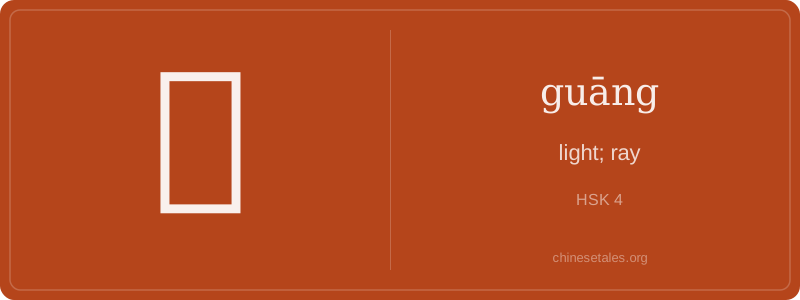
The earliest form of 光 appears in oracle bone script as ⚡️—a stylized person (儿) with a flame or sun-like element above their head (⺌ or ⚡), sometimes with dots suggesting radiating sparks. Over time, the flame evolved into the three-stroke ‘small’ component (⺌) atop 儿, while the person’s legs simplified into the two downward strokes of modern 儿. By the Han dynasty seal script, it was already recognizably 光: a radiant figure, literally 'person + brilliance.' The radical 儿 (child/radical) here isn’t about childhood—it’s the ancient pictograph for a kneeling or standing human, anchoring the character in embodied presence.
This visual logic shaped its semantic journey: from physical radiance (《诗经》: '日出有光', 'At sunrise there is light') to moral luster (Confucius praised rulers who 'shone with virtue'), then to abstraction—'bareness' (as in 光头, 'bald head': no hair = only scalp = only 'light' surface) and 'exclusivity' (光说不做: 'only talk, no action'). Even today, when someone says 我光知道, they’re not claiming knowledge—they’re confessing limitation: 'I *only* know (and nothing more).' The character remains a radiant paradox: simple in stroke count, profound in resonance.
At its heart, 光 isn’t just ‘light’ like a bulb—it’s luminosity with agency: the radiant clarity that dispels ignorance, the glow of honor, even the bare-bones essence of something (as in 光棍, 'bare stick' → bachelor). Chinese doesn’t treat light as passive illumination; it’s an active force—moral, perceptual, and social. That’s why 光 shows up in words like 光荣 (glory) and 光明 (brightness, but also 'uprightness' or 'a hopeful future').
Grammatically, 光 is wonderfully flexible: it can be a noun (阳光, 'sunlight'), an adverb meaning 'only/just' (光吃饭不干活, 'only eats, doesn’t work'), or even a verb in classical usage ('to shine upon'). Learners often overgeneralize this adverbial sense—saying *光去* instead of the correct 光是去 (‘just going’) or confusing it with 只—when 光 implies exclusivity *with a hint of insufficiency* ('just that, and nothing more').
Culturally, 光 carries warmth and virtue: to ‘have light’ (有光) means to have dignity or hope; to ‘lose light’ (失光) suggests moral dimming. A common mistake? Assuming 光 always pairs with 太阳—yet 光 alone suffices for abstract radiance (e.g., 理想之光, 'light of ideals'). Also, watch tone: guāng never becomes guǎng—even though it looks like it might!