区
Character Story & Explanation
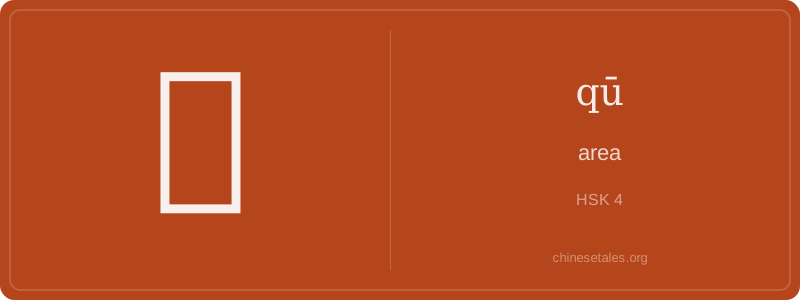
The earliest form of 区 appears in bronze inscriptions as a stylized 'enclosure': two parallel vertical strokes framing a small horizontal stroke inside — like a simple fence around a plot of land or a storage pit. Over time, the top and bottom horizontals became connected, forming the top-left '匚' (bāo) radical (a variant of 匸), while the inner stroke evolved into the distinctive '×' shape — not a multiplication sign, but an ancient symbol for 'contained content' or 'bounded interior.' By the Han dynasty, the four-stroke structure stabilized: 匸 (radical) + × = 区 — literally 'a bounded space with something inside.'
This visual logic directly shaped its semantic evolution. In the *Zuo Zhuan*, 区 referred to 'a reserved section of royal granaries'; by the Tang, it denoted 'administrative subdivisions' under prefectures. The '×' wasn’t arbitrary — it echoed the cross-hatched patterns used in ancient maps to mark designated zones. Even today, when you see 区 on a Beijing subway sign, you’re seeing a 2,500-year-old pictograph of human order imposed on space — a tiny rectangle holding civilization in place.
Think of 区 (qū) as China’s linguistic ZIP code — not just a geographic box on a map, but a conceptual container that holds *anything* with defined boundaries: administrative zones, functional districts, even abstract domains like 'a zone of influence' or 'a danger zone.' Unlike English 'area,' which feels open and vague, 区 carries quiet authority — it’s the character you see on government plaques, subway maps, and app interfaces, always implying official recognition and deliberate demarcation.
Grammatically, 区 is almost always a noun, rarely used alone. It appears in compound nouns (e.g., 商区 shāngqū 'commercial district') or after classifiers like '个' (yī gè qū — 'one district'). Crucially, it’s *not* interchangeable with 地区 (dìqū) or 范围 (fànwéi): while 地区 emphasizes geography and 范围 stresses scope or limits, 区 implies human design — someone drew the line. Learners often mistakenly use 区 where they need 领域 (lǐngyù, 'field/domain'), leading to odd phrasing like 'mathematics area' instead of 'mathematics field.'
Culturally, 区 reflects China’s deep-rooted administrative precision — from Tang dynasty prefectures to today’s 'free trade zones' (自贸区 zìyóu mào yì qū). A common mistake? Confusing qū with qǔ (the tone-3 variant meaning 'melody' or 'region' in classical poetry), or misreading 区 as 巨 (jù, 'huge') due to similar stroke flow. Remember: this character doesn’t describe natural space — it describes *assigned* space.