危
Character Story & Explanation
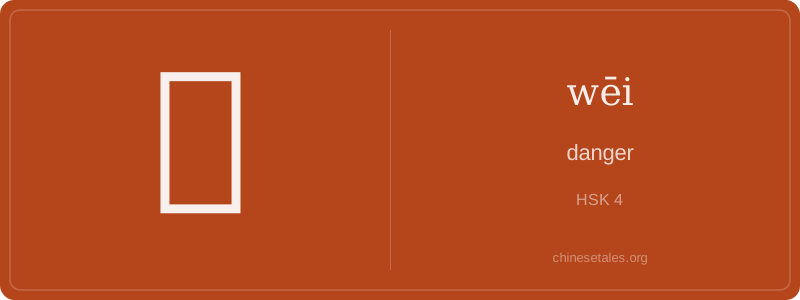
The earliest form of 危 appears in oracle bone inscriptions as a stylized figure standing atop a high platform or cliff — arms raised, body leaning precariously forward. The top part (㔾) evolved from a simplified head-and-arms silhouette, while the bottom (卩) represented a kneeling or crouching posture — but crucially, *off-balance*. Over centuries, the figure shrank and formalized: by the seal script era, the upper component solidified into 㔾 (a radical meaning ‘person on height’), and the lower 卩 became a stable-looking but semantically hollow base — a visual irony: what looks grounded is actually the source of instability.
This tension between appearance and reality shaped its semantic journey. In early texts like the Book of Documents, 危 described both physical peril (‘the mountain path is 危’) and moral peril (‘the ruler’s virtue is 危’). By the Han dynasty, it had crystallized as the go-to character for existential threat — hence its role in classical idioms like 转危为安 (‘turn danger into safety’), where 危 isn’t just risk, but a pivotal, almost metaphysical threshold. Its six strokes aren’t arbitrary: they map the human condition — two strokes for the unsteady head (㔾), four for the fragile foundation (卩 + implied imbalance).
At its heart, 危 isn’t just ‘danger’ like a red traffic light — it’s the *feeling* of standing on a crumbling cliff edge: unstable, precarious, charged with imminent consequence. In Chinese, it carries weight and gravity — you won’t say 危 for a minor spill; it’s reserved for real stakes: collapsing buildings, political instability, or moral collapse. That’s why it rarely stands alone as a noun (unlike English ‘danger’) — it’s almost always part of compounds (危机, 危险) or functions as an adjective meaning ‘perilous’ or ‘critical’.
Grammatically, 危 is a classic HSK 4 trap: learners often misplace it in sentences. It doesn’t take 了 or 过 like verbs — it’s not *‘to danger’*. Instead, it modifies nouns (危房 = dangerous building) or appears in fixed phrases like 危在旦夕 (‘peril is at dawn’s edge’ — i.e., imminent). You’ll also see it in passive-adjacent constructions: 这座桥很危 → ❌ (wrong); correct: 这座桥很危险 → ✅. Why? Because 危 alone is literary/archaic — modern spoken Chinese requires 危险 to sound natural.
Culturally, 危 evokes Confucian caution: the Analects warns ‘君子不立危墙之下’ (a noble person does not stand beneath a crumbling wall) — not just about bricks, but about avoiding morally or socially risky positions. Learners often overuse it trying to sound advanced, but native speakers reach for 危险, 风险, or even 悬 (‘hanging’ — as in 悬了, ‘it’s up in the air!’) for subtlety. Remember: 危 is the sharp, classical blade — elegant, precise, and never casual.