即
Character Story & Explanation
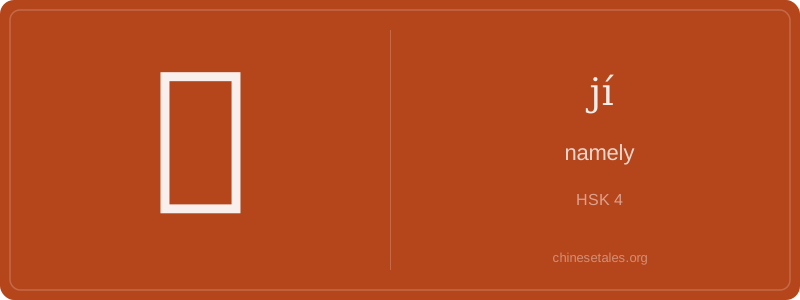
The earliest form of 即 appears on Shang dynasty oracle bones as a pictograph showing a person kneeling beside a food vessel (the ancient '皀' component, now simplified to '卩' + '艮'), facing the meal—literally 'about to eat'. The left side depicted a seated figure (), the right a steaming cauldron (皀). Over centuries, the figure became stylized into 卩 (a seated person radical), and the vessel morphed into 艮 (gèn), a phonetic hint that also meant 'to stop' or 'to face'—reinforcing immediacy and orientation toward something present.
This 'person facing food' image evolved into its modern 7-stroke form: 卩 (kneeling figure) + 艮 (phonetic/semantic anchor). By the Warring States period, 即 shifted from 'about to eat' to the broader sense of 'at this very moment' or 'precisely this'—capturing presence and equivalence. Confucius used 即 in the Analects (e.g., 12.10) to mark definitive moral equivalences: 'Ren is not far off; 即 it is here.' Its visual grounding in proximity and focus made it perfect for logical identification—turning physical nearness into semantic exactness.
Think of 即 (jí) as Chinese punctuation with personality — like a tiny, decisive traffic cop stepping into your sentence to point emphatically: 'Right here! This *is* it!' Its core meaning 'namely' isn’t just definition—it’s an instant, almost ceremonial identification, like saying 'Behold!' before unveiling the punchline. You’ll see it in formal writing and speech when you need precision without fluff: 即 (jí) introduces what follows as the exact, unambiguous explanation or equivalent.
Grammatically, it’s most often used after a noun or phrase, followed by 即 + explanation—e.g., 'The term 'guānxi' 即 (jí) social connections'. It rarely stands alone; it’s always bridging ideas, not starting sentences. Learners often overuse it like English 'that is', but native speakers prefer it sparingly—like a well-placed semicolon, not a comma. Also, don’t confuse it with 'immediately'—that’s 立即 (lìjí), where 即 is part of a compound; alone, 即 doesn’t mean 'right now' unless paired with time words.
Culturally, 即 carries scholarly weight: it’s ubiquitous in textbooks, legal documents, and academic definitions—think of it as the character that says, 'Let’s get our terminology airtight.' A common mistake? Using it conversationally ('I’m tired, 即 I’m going to bed')—nope! That’s unnatural. Save 即 for moments when clarity is non-negotiable, like labeling a diagram or defining a technical term. It’s not casual—it’s concise authority.