却
Character Story & Explanation
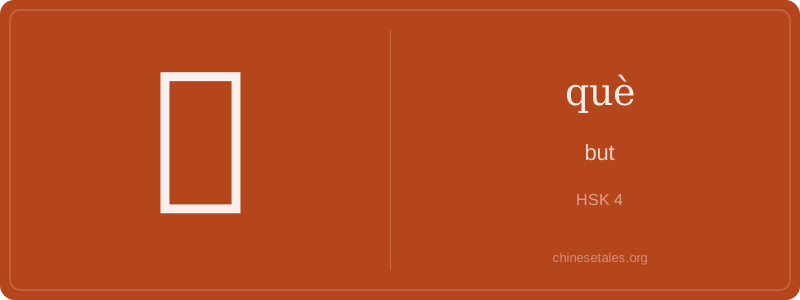
Carved on Shang dynasty oracle bones over 3,000 years ago, the earliest form of 却 resembled a kneeling figure (the radical 卩) with a hand (又) pushing away or turning aside — literally 'a person withdrawing'. The bronze script added clarity: the left side solidified into 卩 (jié), the ancient pictograph for a person in ritual posture, while the right evolved from 又 (yòu, 'hand') plus 去 (qù, 'to go away'), suggesting deliberate reversal or stepping back. By the seal script era, strokes streamlined into today’s elegant seven-stroke form: the top stroke curves like a retreating step, the vertical 卩 anchors the posture, and the final dot is the quiet 'snap' of decision.
This visual narrative of withdrawal directly shaped its semantic journey. In the Classic of Poetry and early texts, 却 meant 'to reject', 'to repel', or 'to withdraw' — as in '却敌' (repel the enemy). Over centuries, that physical act of turning away morphed into a logical one: turning away from expectation → introducing contrast. By the Tang dynasty, poets like Du Fu used 却 to mark poignant reversals ('却看妻子愁何在' — 'then I look back at my wife and children — where is their sorrow?'), embedding emotional nuance into syntactic structure. Its shape still whispers 'step back before you pivot'.
At first glance, 却 (què) seems like a simple 'but' — but it’s actually a quiet powerhouse of contrast and subtle resistance. Unlike English ‘but’, which often introduces outright contradiction, 卻 carries a gentle, almost reluctant pivot: it signals that something *unexpectedly* diverges from expectation or prior context. Think of it as the linguistic equivalent of raising an eyebrow — not shouting disagreement, but quietly noting an elegant twist in logic. It’s rarely used at the start of a sentence; instead, it nestles mid-clause, after a comma or conjunction, lending sophistication to written and formal spoken Chinese.
Grammatically, 却 always follows a clause and precedes another — never standing alone. You’ll see it paired with 虽然 (although), 尽管 (even though), or even implied contrast: '他很累,却坚持工作。' (Tā hěn lèi, què jiānchí gōngzuò.) — 'He was very tired, yet he persisted in working.' Notice how 却 softens the contrast compared to 可是 or 但是: it implies admiration, irony, or quiet resilience rather than mere opposition. Learners often mistakenly place it sentence-initially ('Què tā…') — a red flag that instantly sounds unnatural to native ears.
Culturally, 却 reflects a preference for indirectness and layered meaning: the contrast isn’t confrontational, but contextual and relational — like a brushstroke that gains power only because of the blank space beside it. A classic learner trap? Overusing it where Mandarin prefers silence or a simple comma. In classical poetry, 却 appears in lines like 李白’s '却下水晶帘' — where it means 'then (unexpectedly) lowers…', revealing its original sense of 'to retreat' or 'to turn back', still faintly echoing in its modern contrastive force.