厚
Character Story & Explanation
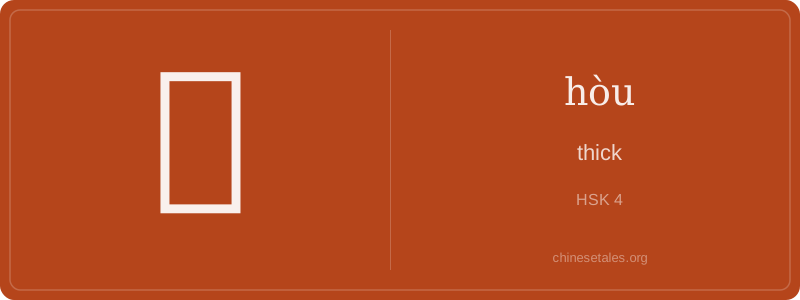
The earliest form of 厚 appears in bronze inscriptions as a combination of 厂 (a cliff or sheltering roof) and (an ancient variant of 㫃, suggesting layered cloth or folded material). Over time, the lower part evolved into (a simplified representation of stacked layers), then standardized into the modern 口 + 子 structure beneath 厂 — visually stacking ‘layers’ under a protective overhang. The nine strokes map perfectly to this idea: the top 厂 (2 strokes) shelters three stacked horizontal lines (3 strokes in 口) plus the ‘child’ element 子 (3 strokes), and one final stroke to seal the base — embodying accumulation, protection, and density.
This visual stacking directly shaped its meaning: from physical thickness (of walls, books, ice) to metaphorical ‘thickness’ in human qualities — sincerity, generosity, and moral weight. Mencius (3rd c. BCE) praised rulers who ‘thicken their virtue’ (厚德), linking physical density to ethical substance. Even today, calling someone 厚道 isn’t just ‘nice’ — it’s praising their deep-rooted, unwavering integrity, like soil rich enough to grow strong trees.
At its core, 厚 (hòu) isn’t just about physical thickness — it’s about *substance*, *weightiness*, and *richness* in both literal and deeply cultural senses. Think of a thick slice of aged ham, a thick layer of snow, or even a thick, warm blanket — all evoke warmth, abundance, and comforting density. In Chinese, this character carries emotional and moral heft too: a ‘thick’ heart (厚道, hòu·dào) means sincere and kind; ‘thick virtue’ (厚德, hòu dé) is a Confucian ideal of profound moral cultivation.
Grammatically, 厚 is mostly an adjective, but unlike English ‘thick’, it rarely stands alone before a noun without modification. You’ll almost always see it with 的 (e.g., 厚的书, hòu de shū — ‘a thick book’) or in fixed compounds. Crucially, it’s *not* used for abstract ‘thickness’ like ‘a thick accent’ — that’s 重 (zhòng) or 浓 (nóng). Learners often mistakenly say *hòu kǒuyīn* (‘thick accent’), but native speakers say *kǒuyīn hěn zhòng* (‘accent is very heavy/strong’).
Culturally, 厚 appears in classical phrases like 厚此薄彼 (hòu cǐ bó bǐ — ‘favor one over the other’), revealing how deeply ‘thickness’ implies preferential treatment — literally ‘making this side thick, that side thin’. Also watch tone: it’s fourth tone (hòu), not second (hóu) — mispronouncing it as *hóu* may accidentally summon the homophone 猴 (monkey)!