吸
Character Story & Explanation
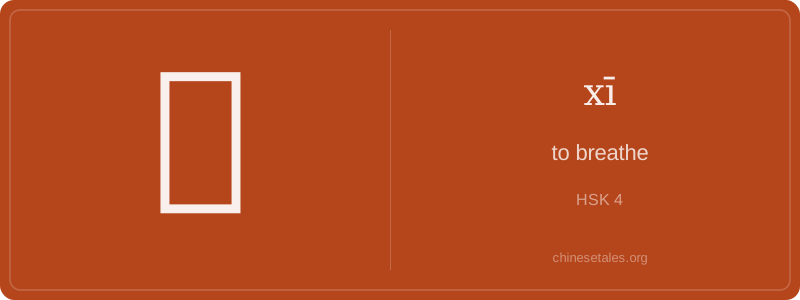
The earliest form of 吸 appears in bronze inscriptions as a combination of 口 (mouth) and 极 (a variant of 及, meaning ‘to reach’ or ‘to grasp’), suggesting the mouth reaching out to draw something in. In oracle bone script, it was even more vivid: a stylized mouth with a curved line extending outward — like an invisible thread pulling air inward. Over centuries, the right side simplified from 及 to 汲 (jí, ‘to draw water’), then further to the modern 氵+及-like shape — but crucially, the left 口 remained dominant, anchoring the meaning in oral, bodily action.
This visual logic shaped its semantic journey. In classical texts like the Zhuangzi, 吸 appears in meditative contexts: ‘吐故纳新,吸清呼浊’ (‘expel the old, take in the new; inhale the clear, exhale the turbid’) — linking breath to moral and cosmic renewal. The character never meant ‘breathe’ in the neutral, automatic sense; it always carried intentionality. Even today, when we say 吸引 (‘attract’), we’re invoking that ancient image: not passive liking, but an irresistible, mouth-like pull — as if the heart itself opens wide to draw something near.
At its core, 吸 (xī) isn’t just ‘to breathe’ — it’s the visceral, life-sustaining *pull* of air into the body, carrying with it connotations of drawing in, absorbing, or even being captivated. Unlike English verbs that separate ‘breathe in’ and ‘inhale’, 吸 is inherently directional: it always implies movement *toward* or *into*. That’s why you 吸烟 (xī yān, ‘inhale smoke’) but never *exhale* smoke with this character — for that, you’d use 呼 (hū). This directional gravity shapes how native speakers think about intake: not passive reception, but active, focused drawing-in.
Grammatically, 吸 is almost always transitive — it needs an object (what is being drawn in). You don’t just ‘xī’; you xī something: 氧气 (oxygen), 烟 (smoke), 注意力 (attention). It also appears in common serial verb constructions like 吸取 (xī qǔ, ‘draw and take’ → ‘absorb/learn from’), where 吸 sets the direction before the second verb completes the action. Learners often mistakenly use it intransitively (e.g., *他吸了* without an object) — a red flag to native ears.
Culturally, 吸 carries subtle weight around self-control and modernity. Smoking (吸烟) is legally permitted but socially stigmatized; the very word 吸烟 subtly frames smoking as an act of *intake*, inviting reflection on agency and habit. And in tech contexts, 吸引 (xī yǐn, ‘attract’) reveals how deeply physical metaphors run: attraction isn’t abstract — it’s a magnetic *pull*, like breath drawn toward warmth. Mispronouncing it as xí (second tone) is common — but xí means ‘to attack’ (袭), a dangerous slip!