咱
Character Story & Explanation
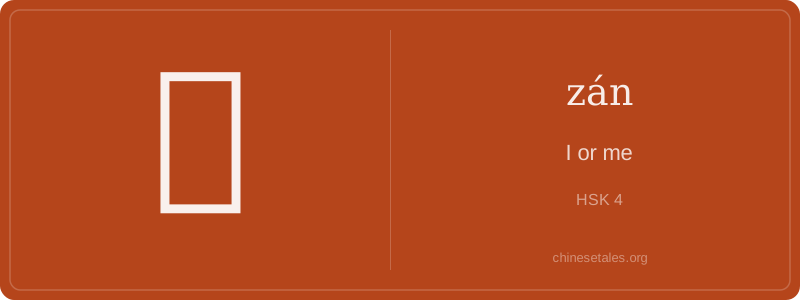
The earliest form of 咱 appears not in oracle bones but in late Ming vernacular texts — it’s a relatively young character, born from phonetic-semantic fusion. Its left side 口 (kǒu, 'mouth') signals speech and colloquial usage; its right side 自 (zì, 'self') originally meant 'nose' in ancient scripts but evolved to mean 'self' or 'one’s own'. Visually, it’s nine strokes: three for 口 (vertical, horizontal-fold, closing horizontal), then six for 自 (dot, vertical, three horizontals, hook). Over centuries, the top dot of 自 simplified, and the lower strokes tightened — making the modern 咱 look like 'a mouth speaking for oneself'.
This visual logic mirrors its semantic birth: 咱 emerged in Yuan and Ming dynasty storytelling and opera as a spoken variant of 自 (zì), pronounced similarly but softened to zán to sound warmer and more inclusive. In the classic novel Water Margin, characters from Shandong and Hebei use 咱 when pledging loyalty — '咱兄弟' (zán xiōngdì, 'us brothers') implying kinship beyond blood. The character never appeared in classical literary Chinese; it’s a linguistic hug born from everyday talk — proof that Mandarin’s most intimate pronouns weren’t decreed by scholars, but forged in teahouses and courtyards.
咱 (zán) is the warm, inclusive 'we' — but not just any 'we'. It’s the cozy, down-to-earth pronoun you’d use with family, close friends, or neighbors in northern China, meaning 'I/me' *when including the listener* ('us', 'we', or even 'I' as a humble or collective self-reference). Unlike formal 我 (wǒ), 咱 carries emotional weight: it signals trust, familiarity, and shared identity. You’ll hear it in Beijing hutongs, Shandong villages, and in dialect-influenced Mandarin — but rarely in formal writing or southern speech.
Grammatically, 咱 functions like a first-person pronoun but behaves uniquely: it can be singular ('I') *or* plural ('we'), depending entirely on context and intonation. '咱走吧' (zán zǒu ba) usually means 'Let’s go' (inclusive), but in some contexts — especially with a rising tone or added emphasis — it can mean 'I’m leaving' (humble/colloquial 'I'). Crucially, it *never* takes possessive 的: you say 咱家 (zán jiā, 'our home'), not *咱的家. Also, it’s almost always followed by a verb or particle — never used bare in formal sentences.
Culturally, 咱 reveals how Chinese pronouns encode social intimacy. Learners often overuse it, sounding falsely familiar — imagine saying 'zán' to your professor! Others avoid it entirely, missing its expressive power in spoken Mandarin. And here’s a sneaky trap: in written dialogue (novels, subtitles), 咱 frequently appears where standard Mandarin would use 我 — signaling regional identity or character warmth. So while HSK 4 lists it as 'I/me', its real magic lies in the unspoken bond it creates between speaker and listener.