咳
Character Story & Explanation
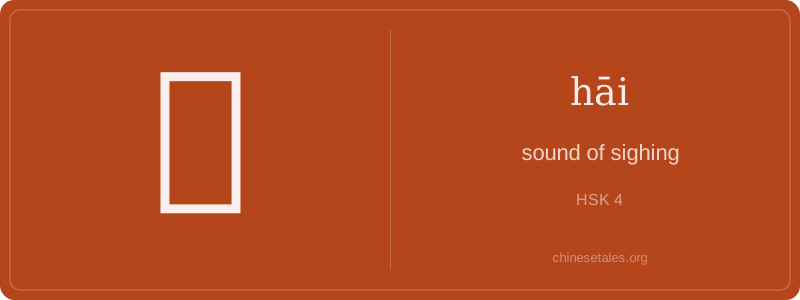
Carved over 3,000 years ago in oracle bone script, 咳 began as two distinct elements: 口 (mouth, radical) on the left — unmistakably a pictograph of an open mouth — and the right side, originally a stylized depiction of a person with arms raised and head tilted back, exhaling. That right component evolved through bronze inscriptions into the modern ‘亥’ (hài), which originally meant ‘the last of the twelve Earthly Branches’ but was borrowed here purely for sound — a classic case of phonetic loan. By the Small Seal Script era, the two halves fused: 口 + 亥 became a single, balanced 9-stroke character, its shape mirroring the physical act — mouth open, breath released, body relaxed in resignation.
By the Han dynasty, 咳 appeared in texts like the *Shuōwén Jiězì* as an interjection expressing sorrow or regret — notably in the phrase 咳唾成珠 ('a sigh or spit becomes a pearl'), metaphorically praising eloquent, heartfelt speech. Its meaning never drifted far from breath-as-emotion: in Tang poetry, it punctuated quiet despair; in Ming vernacular fiction, it signaled a character’s weary concession. The visual logic remains perfect: 口 announces 'this is vocal', and 亥 (though silent in this reading) anchors it in rhythm — nine strokes, like nine slow exhales.
咳 (hāi) is the written echo of a sigh — not a cough, not a gasp, but that soft, breathy exhalation when you’re tired, disappointed, or just mentally shrugging. It’s an onomatopoeic interjection, like English 'huh' or 'phew', and lives almost exclusively in spoken-style writing: novels, dialogues, subtitles — anywhere you want to show a character’s unspoken weariness or mild exasperation. Crucially, it’s never used alone as a sentence; it always appears at the start or mid-sentence, followed by punctuation (often '!' or '…') or integrated into dialogue tags — think 咳,算了!('Hāi, forget it!').
Grammatically, it functions like a discourse particle — zero grammatical weight but high emotional texture. You won’t find it in formal reports or academic essays. Learners sometimes mistakenly use it like 啊 or 呀 (as a modal particle), but 咳 doesn’t attach to verbs or adjectives — it stands apart, breath-first. Also, don’t confuse its primary pronunciation hāi with ké (used only in medical contexts like 咳嗽 'cough', where it’s part of a compound and never standalone). That ké is silent in isolation — if you say 'ké' alone, native speakers will blink and ask, 'Coughing *what*?'
Culturally, 咳 carries a gentle, almost literary melancholy — it’s the sound of Lin Daiyu pausing before another poetic lament in *Dream of the Red Chamber*. Overuse feels theatrical or old-fashioned; underuse misses a subtle layer of Chinese emotional subtext. And yes — it’s HSK 4, not because it’s hard, but because mastering these tiny vocal gestures is where fluency gets human.