咸
Character Story & Explanation
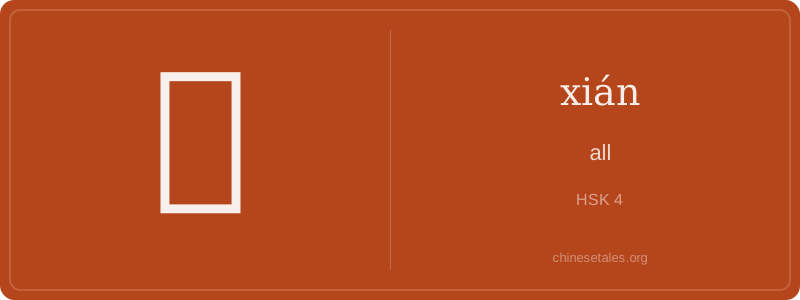
The earliest form of 咸 appears in bronze inscriptions as ⿱戌口 — a ‘halberd’ (戌) above a ‘mouth’ (口). The halberd wasn’t just a weapon; in Shang-Zhou ritual contexts, it symbolized authority, enforcement, and collective action—think of a commander raising his weapon to signal unified movement. Over centuries, the top evolved: 戌 simplified into the current 戋 (jiān, ‘small, few’), while the mouth radical remained firmly anchored below. By the seal script era, the shape stabilized into today’s nine-stroke form: 戔 + 口 — visually echoing ‘a small thing applied universally’, hinting at totality through repetition or extension.
This evolution mirrors its semantic journey: from ‘to enforce unity’ (bronze age) → ‘to be complete, all-inclusive’ (Warring States classics) → the refined, almost ceremonial ‘all’ found in Confucian texts. Notably, the Shuōwén Jiězì (121 CE) defines it as ‘皆也’ (‘all, every’), confirming its early grammatical role. Its visual duality—‘small’ (戋) governing ‘speech’ (口)—suggests ‘every voice counted’, a quiet nod to early notions of collective consensus long before democracy had a name in China.
Don’t let the pinyin xián fool you—this character has almost nothing to do with salt (that’s the homophone 咸 meaning ‘salty’, which shares the same pronunciation but is a completely different character in classical usage!). In modern Standard Chinese, 咸 functions as an elegant, slightly literary word for ‘all’ or ‘every’, often appearing in fixed expressions like 咸知 (‘all know’) or 咸宜 (‘suitable for all’). It carries a formal, classical weight—you’ll rarely hear it in casual speech, but you’ll see it on temple inscriptions, official documents, or poetic prose. Think of it as Mandarin’s ‘ye olde’ version of ‘all’.
Grammatically, 咸 is a pre-verbal adverb, placed right before the verb—never after, never alone as a subject. You’d say 咸认 (xián rèn, ‘all acknowledge’), not *认咸. It’s also exclusively used in compound words or set phrases; you’ll never use it solo like 都 or 全. A classic mistake? Learners try to replace 都 with 咸 in everyday sentences (e.g., *我们都去了 → *我们咸去了), which sounds archaic and jarring—like saying ‘Verily, we did go forth’ at a coffee shop.
Culturally, 咸 appears in foundational texts: the Book of Documents opens with ‘曰若稽古帝堯,曰放勳,欽明文思安安,允恭克讓,光被四表,格於上下,克明俊德,以親九族…九族既睦,平章百姓,百姓昭明,協和萬邦,黎民於變時雍。’ — and later, ‘咸有一德’ (xián yǒu yī dé, ‘all possess one virtue’) became a Confucian ideal. Its rarity today makes it a subtle marker of linguistic sophistication—and a telltale sign that the writer has brushed up against classical Chinese.